%20%20--%3E%0A%3Csvg%20version%3D%221.1%22%20xmlns%3D%22http%3A%2F%2Fwww.w3.org%2F2000%2Fsvg%22%20xmlns%3Axlink%3D%22http%3A%2F%2Fwww.w3.org%2F1999%2Fxlink%22%20x%3D%220px%22%20y%3D%220px%22%0A%09%20viewBox%3D%220%200%201092.7%20200%22%20style%3D%22enable-background%3Anew%200%200%201092.7%20200%3B%22%20xml%3Aspace%3D%22preserve%22%3E%0A%3Cstyle%20type%3D%22text%2Fcss%22%3E%0A%09.st0%7Bfill%3A%23231F20%3B%7D%0A%09.st1%7Bfill%3A%23293576%3B%7D%0A%09.st2%7Bfill%3A%23C82C2D%3B%7D%0A%09.st3%7Bfill%3A%23FFFFFF%3B%7D%0A%3C%2Fstyle%3E%0A%3Cg%20id%3D%22Template%22%3E%0A%3C%2Fg%3E%0A%3Cg%20id%3D%22Layer_2%22%3E%0A%09%3Cpolygon%20class%3D%22st3%22%20points%3D%2256.8%2C78.5%2073.1%2C78.5%2085.5%2C78.5%2085.5%2C36.3%2085.5%2C0%2068.8%2C0%2064.9%2C6.2%2063.3%2C8.7%2052%2C0%2025.5%2C0%2021.8%2C3.8%20%0A%09%092%2C23.8%202%2C176.2%2025%2C200%2061.5%2C200%2085.5%2C176.2%2085.5%2C121.5%2056.8%2C121.5%2056.8%2C176.2%2039.5%2C176.2%2039.5%2C32.4%2039.5%2C23.8%2056.8%2C23.8%2056.8%2C57.2%20%0A%09%09%09%22%2F%3E%0A%09%3Cpolygon%20class%3D%22st3%22%20points%3D%22143.9%2C104.2%20143.9%2C48.1%20143.9%2C24.2%20152.1%2C24.2%20153.2%2C24.2%20153.2%2C0%20152.1%2C0%20106.8%2C0%2093.9%2C0%2093.9%2C24.2%20%0A%09%09106.7%2C24.2%20106.7%2C63.4%20106.7%2C116.9%20106.7%2C175.8%20130.4%2C200%20169.2%2C200%20183%2C184.8%20191.2%2C175.8%20191.2%2C146.2%20191.2%2C96.1%20191.2%2C24.2%20%0A%09%09201.4%2C24.2%20201.4%2C0%20163.7%2C0%20158.7%2C0%20158.7%2C24.2%20163.7%2C24.2%20169.2%2C24.2%20169.2%2C75.2%20169.2%2C127.8%20169.2%2C174.1%20169.2%2C175.8%20%0A%09%09143.9%2C175.8%20143.9%2C152.9%20%09%22%2F%3E%0A%09%3Cpath%20class%3D%22st3%22%20d%3D%22M220.3%2C168v8.3h-10.5V200h62.1h12.7l28.5-23.8v-66l-5.2-5.1l-7.8-7.6l7.8-7.8l2.5-2.5V60V25.7%0A%09%09c0%2C0.7-8.6-7.9-25.7-25.7h-43H230h-20.2v23.8h10.5v96.7V168z%20M257.5%2C23.8h22.2v60.5h-22.2V23.8z%20M257.5%2C110.3h22.2v50.2v15.8h-22.2%0A%09%09v-29.4V110.3z%22%2F%3E%0A%09%3Cpath%20class%3D%22st3%22%20d%3D%22M331.9%2C176.2h-10.5v6V200h42.8h21.4h10.5l1-0.9l27.4-22.9v-56.9v-9.1l-13-12.8l10.3-10.2V25.7%0A%09%09c0%2C0.7-8.6-7.9-25.7-25.7h-74.8v23.8h10.5V45V176.2z%20M391.4%2C176.2h-5.8h-16.5v-66h22.2v17.9V176.2z%20M369.2%2C23.8h22.2v60.5H376h-6.9%0A%09%09v-5.6V23.8z%22%2F%3E%0A%09%3Cpolygon%20class%3D%22st3%22%20points%3D%22443.3%2C175.8%20433%2C175.8%20433%2C200%20463.5%2C200%20475%2C200%20489.5%2C200%20489.5%2C175.8%20480%2C175.8%20480%2C147.6%20%0A%09%09480%2C25.5%20489.5%2C25.5%20489.5%2C0%20433%2C0%20433%2C25.5%20443.3%2C25.5%20443.3%2C130.4%20%09%22%2F%3E%0A%09%3Cpolygon%20class%3D%22st3%22%20points%3D%22505.6%2C175.8%20497.9%2C175.8%20497.9%2C200%20541.3%2C200%20552.9%2C200%20583.6%2C200%20595.1%2C187.7%20595.1%2C153.9%20%0A%09%09595.1%2C140.7%20566.9%2C140.7%20566.9%2C159.5%20566.9%2C175.8%20542.6%2C175.8%20542.6%2C160.5%20542.6%2C115.8%20556.6%2C115.8%20556.6%2C133%20580.1%2C133%20%0A%09%09580.1%2C67.7%20556.6%2C67.7%20556.6%2C85%20542.6%2C85%20542.6%2C25.5%20566.9%2C25.5%20566.9%2C60.8%20595.1%2C60.8%20595.1%2C0%20497.9%2C0%20497.9%2C25.5%20505.6%2C25.5%20%0A%09%09505.6%2C155.6%20%09%22%2F%3E%0A%09%3Cpolygon%20class%3D%22st3%22%20points%3D%22682.8%2C73.5%20682.8%2C0%20669.5%2C0%20659%2C5.5%20652.7%2C0%20627.3%2C0%20603.5%2C24.2%20603.5%2C91.7%20628.1%2C116.2%20654.3%2C116.2%20%0A%09%09654.3%2C128.5%20654.3%2C176.2%20630.8%2C176.2%20630.8%2C140.6%20630.8%2C128.7%20604.5%2C128.7%20604.5%2C151%20604.5%2C200%20619.1%2C200%20625%2C200%20629.8%2C195.2%20%0A%09%09630.7%2C195.9%20637%2C200%20666.3%2C200%20687.5%2C176.2%20687.5%2C107.3%20687.5%2C106.8%20667%2C83%20635.5%2C83%20635.5%2C24.2%20656.8%2C24.2%20656.8%2C73.5%20%09%22%2F%3E%0A%09%3Cpolygon%20class%3D%22st2%22%20points%3D%22774%2C78.5%20774.8%2C78.5%20786.4%2C78.5%20802.8%2C78.5%20802.8%2C0.7%20802.8%2C0%20786%2C0%20780.5%2C8.7%20769.3%2C0%20742.8%2C0%20%0A%09%09719.3%2C23.8%20719.3%2C83.3%20719.3%2C176.2%20739%2C196.6%20742.3%2C200%20778.8%2C200%20802.8%2C176.2%20802.8%2C167%20802.8%2C121.5%20786.4%2C121.5%20774.8%2C121.5%20%0A%09%09774%2C121.5%20774%2C176.2%20756.8%2C176.2%20756.8%2C50.3%20756.8%2C23.8%20774%2C23.8%20774%2C33.1%20%09%22%2F%3E%0A%09%3Cpath%20class%3D%22st2%22%20d%3D%22M821.4%2C176.2h-10.2V200h11.2h45.8v-23.8h-6.5h-3v-65h5.5h11.7v7.6v47.7v9.7l14.7%2C23.3l0.3%2C0.4h25.2v-19v-4.8%0A%09%09h-5.5V140v-25.6l-13.3-13.3l-0.2-0.2l2.2-1.5l11.3-7.8v-2.5V24.2L882.4%2C0h-18.2h-11.6h-41.5v24.2h10.2v132.1V176.2z%20M858.7%2C24.2%0A%09%09h5.5h12.5V87h-12.5h-5.5V24.2z%22%2F%3E%0A%09%3Cpolygon%20class%3D%22st2%22%20points%3D%22934.8%2C166.2%20934.8%2C175.8%20924.5%2C175.8%20924.5%2C200%20981%2C200%20981%2C175.8%20971.5%2C175.8%20971.5%2C133.1%20%0A%09%09971.5%2C81.9%20971.5%2C25.5%20981%2C25.5%20981%2C9.1%20981%2C0%20942%2C0%20930.5%2C0%20924.5%2C0%20924.5%2C25.5%20930.5%2C25.5%20934.8%2C25.5%20934.8%2C119%20%09%22%2F%3E%0A%09%3Cpath%20class%3D%22st2%22%20d%3D%22M1089.9%2C87.2V25.7c0%2C0.6-6.4-5.8-19.3-19c-2-2.1-4.2-4.3-6.5-6.7h-31h-43.7v23.8h10.5v24.2v55.5v72.8h-10.5%0A%09%09V200h74.8l28.5-23.8v-66l-13-12.8L1089.9%2C87.2z%20M1059.4%2C176.2h-22.2v-66h22.2V176.2z%20M1059.4%2C84.2h-22.2V57.5V23.8h22.2V25V84.2z%22%0A%09%09%2F%3E%0A%3C%2Fg%3E%0A%3C%2Fsvg%3E%0A)

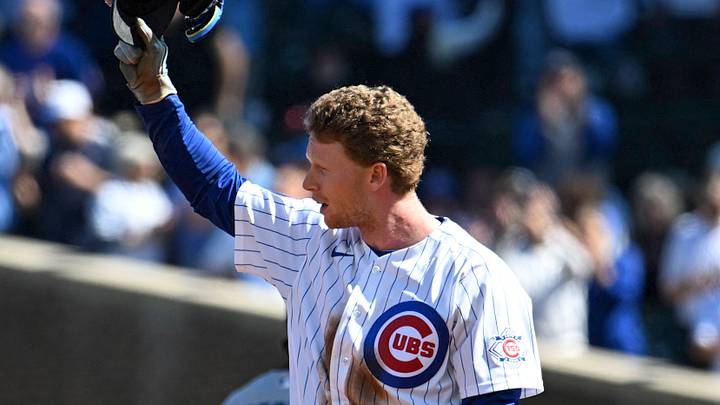
To say the end of the 2026 Chicago Cubs season left a bad taste in everyone's mouth would be the understatement of the century. The year, by most standards, was an abject failure. Craig Counsell's club not only failed spectacularly to catch the Milwaukee Brewers, but they couldn't even surpass their 2025 selves, ending with a worse record and playoff finish despite some big new additions. Moreover, everyone's fears about their pitching staff and lack of development were exacerbated in a year defined by injury and underperformance on that side of the ball.
However, two things can be true. This season can be a step backward while still being an entertaining ride. This team won 89 games despite a pitching staff that required a multitude of fixes mid-season to get by. That's thanks to a Cubs offense that, despite its inconsistencies, was the top run-scoring unit in the league, and a downright historic defense that lapped the field in major categories like outs above average and defensive runs saved.
On an individual level, a lot of great things happened this year. Let's look back at four standout storylines that represented the highs of the Cubs' season.
Pete Crow-Armstrong ascended to superstardom with a 40-40 season
I mean, come on. There was no greater development for the Cubs in 2026 than Pete Crow-Armstrong reaching his superstar potential. Everyone saw the flashes in 2025 after an eye-opening first half of the year, but this time, he put it all together for a season that ranks among the best by a Northsider. By fWAR, his 10.6 mark would be the second most valuable in team history, behind only Rogers Hornsby's monstrous 11 WAR 1929 campaign.
The most encouraging part of the season was how PCA made great strides over his greatest weakness — his chase rate. In just one season, he cut down his chase percentage by over 7% to 34.1%, which is still high, but far more manageable. Not only that, but it helped him nearly triple his walk rate to 11.4%, going from the 4th percentile of all players to the 80th! Those kinds of changes don't usually happen at that pace, and it made his final slash line of .280/.372/.570 with a 157 wRC+ — second to only the likely AL MVP Yordan Alvarez — possible.
The cherry on top was, of course, the 7th 40-40 season ever recorded. PCA tied Kyle Schwarber for the league lead in home runs with 45 while also stealing 41 bases and etching himself into the history books. Oh, and he played his typical brand of otherworldly center field defense while doing that all. Sure, he has to work on his performance in the postseason, but there's no question the Cubs now have one of baseball's finest players locked up for the foreseeable future.
40/40 🔥
— Six Point Sports (@SixPointSports) September 24, 2026
PCA HAS DONE IT! pic.twitter.com/836gyELl9f
Alex Bregman's turnaround gave hope for the Cubs' future
Can you imagine how awful this season would've felt if Alex Bregman hadn't pulled a complete 180 in the second half? The Cubs' big-ticket free agent third baseman didn't quite live up to the hype through the first half, with offense that stood around league average. Fans were not exactly pleased with the team's first real modern blockbuster signing. Yet, down the stretch, he was right there with PCA, helping to carry the team into the postseason with a surge of home runs and a return to his best form.
Despite his sluggish start, Bregman finished the year with a .265/.355/.464 slash line and 128 wRC+, good for top-30 in baseball. In the second half, though, he was the outright best hitter in MLB, slashing .303/.384/.626 with a 176 wRC+, ahead of Crow-Armstrong, Fernando Tatis Jr., and Alvarez. All the while, he played excellent defense at the hot corner, which made him a perfect fit for a team that thrived with its gloves. Even when his face was broken by a foul ball, he still fought his way back out there and hit two home runs against the Red Sox in Tampa Bay to close out the year on a high.
He, too, may have vanished in the postseason, but he's given more than enough reason not to fear what the front end of his contract will look like in Chicago.
Pedro Ramirez burst onto the scene as a big-league contributor
It's almost hard to believe that Pedro Ramirez wasn't really on the radar this year as a big-league contributor. As recently as last year, the switch-hitting utility man wasn't even in the organization's top ten prospects, let alone on the radar for a role with the Cubs. That all changed when he exploded at Triple-A with a .312/.395/.547 slash line and a 138 wRC+, all while keeping a low strikeout rate of 16.3%. His transformation, headlined by a massive increase in power, suddenly shot him up the prospect rankings and firmly into Counsell's sights. An injury to Matt Shaw opened the door for him to contribute, and he never really looked back from there.
For a player not viewed as a top prospect who was experiencing his first season in Iowa and was also blocked at the majors by an infield of high-dollar players, the substantial role Ramirez ended up playing with the team is nothing short of impressive. He ended up appearing in nearly half of the Cubs' games this year and racked up over 260 plate appearances. While his final slash line was only .261/.321/.402, good for a perfectly average 100 wRC+, he proved his ability to hang with the toughest competition. He's also just 22 years old, meaning this could just be the beginning of a promising big league career.
The best organizations need surprises on the farm system now and then to sustain big-league success. The Cubs haven't figured that out on the pitching side, but Ramirez was a delightful outcome who not only gave this year's team extra depth but also an exciting future. He was a big part of why the team had such a strong bench all year alongside Shaw and Michael Conforto, who also deserves an honorable mention for his bounceback year as a role player with a .240/.331/.469/119 wRC+ line in 314 plate appearances.
David Peterson was better than the Cubs could've possibly hoped
Of the few good pitching stories for the Cubs this year, almost all of them come with glaring asterisks. Ben Brown began breaking out as a starter, but his year was cut short once again by a stress reaction in his neck. Shota Imanaga had a solid bounceback year, but still gave up way too many home runs. The only two clear-cut positive developments for this team were Ryan Rolison and David Peterson. And while Rolison absolutely deserves his flowers for being this year's Brad Keller to a degree, with a 3.13 ERA and 3.93 FIP in 63 innings, it would be remiss not to highlight how Peterson may have saved this team.
Hoyer made the deal with the New York Mets for Peterson back in June when their injury issues hit critical mass. They gave up their #13 prospect, Cole Mathis, to land the swingman amid a nightmarish year in Queens, in which he posted a 6.09 ERA in 68 innings. It was mostly a desperation play, but not an entirely ill-advised one given his groundball proficiency and a much more respectable 3.85 FIP. Sure enough, in front of the Cubs' defense, he massively played up with a 3.70 ERA and 4.06 FIP.
However, those numbers don't tell the full story. After a disastrous second start with the Northsiders in which he gave up ten earned runs against the Cardinals, Peterson only had one obvious clunker the rest of the way. From July 9 onward, he had the best ERA of any Cubs pitcher at 2.66, good for 13th best in all of baseball. He was an oasis in a desert of starting pitching success for this team, and one they should absolutely explore bringing back for next year given how well his 50.1% groundball rate fits them.
 Add us as a preferred source on Google