%20%20--%3E%0A%3Csvg%20version%3D%221.1%22%20xmlns%3D%22http%3A%2F%2Fwww.w3.org%2F2000%2Fsvg%22%20xmlns%3Axlink%3D%22http%3A%2F%2Fwww.w3.org%2F1999%2Fxlink%22%20x%3D%220px%22%20y%3D%220px%22%0A%09%20viewBox%3D%220%200%201092.7%20200%22%20style%3D%22enable-background%3Anew%200%200%201092.7%20200%3B%22%20xml%3Aspace%3D%22preserve%22%3E%0A%3Cstyle%20type%3D%22text%2Fcss%22%3E%0A%09.st0%7Bfill%3A%23231F20%3B%7D%0A%09.st1%7Bfill%3A%23293576%3B%7D%0A%09.st2%7Bfill%3A%23C82C2D%3B%7D%0A%09.st3%7Bfill%3A%23FFFFFF%3B%7D%0A%3C%2Fstyle%3E%0A%3Cg%20id%3D%22Template%22%3E%0A%3C%2Fg%3E%0A%3Cg%20id%3D%22Layer_2%22%3E%0A%09%3Cpolygon%20class%3D%22st3%22%20points%3D%2256.8%2C78.5%2073.1%2C78.5%2085.5%2C78.5%2085.5%2C36.3%2085.5%2C0%2068.8%2C0%2064.9%2C6.2%2063.3%2C8.7%2052%2C0%2025.5%2C0%2021.8%2C3.8%20%0A%09%092%2C23.8%202%2C176.2%2025%2C200%2061.5%2C200%2085.5%2C176.2%2085.5%2C121.5%2056.8%2C121.5%2056.8%2C176.2%2039.5%2C176.2%2039.5%2C32.4%2039.5%2C23.8%2056.8%2C23.8%2056.8%2C57.2%20%0A%09%09%09%22%2F%3E%0A%09%3Cpolygon%20class%3D%22st3%22%20points%3D%22143.9%2C104.2%20143.9%2C48.1%20143.9%2C24.2%20152.1%2C24.2%20153.2%2C24.2%20153.2%2C0%20152.1%2C0%20106.8%2C0%2093.9%2C0%2093.9%2C24.2%20%0A%09%09106.7%2C24.2%20106.7%2C63.4%20106.7%2C116.9%20106.7%2C175.8%20130.4%2C200%20169.2%2C200%20183%2C184.8%20191.2%2C175.8%20191.2%2C146.2%20191.2%2C96.1%20191.2%2C24.2%20%0A%09%09201.4%2C24.2%20201.4%2C0%20163.7%2C0%20158.7%2C0%20158.7%2C24.2%20163.7%2C24.2%20169.2%2C24.2%20169.2%2C75.2%20169.2%2C127.8%20169.2%2C174.1%20169.2%2C175.8%20%0A%09%09143.9%2C175.8%20143.9%2C152.9%20%09%22%2F%3E%0A%09%3Cpath%20class%3D%22st3%22%20d%3D%22M220.3%2C168v8.3h-10.5V200h62.1h12.7l28.5-23.8v-66l-5.2-5.1l-7.8-7.6l7.8-7.8l2.5-2.5V60V25.7%0A%09%09c0%2C0.7-8.6-7.9-25.7-25.7h-43H230h-20.2v23.8h10.5v96.7V168z%20M257.5%2C23.8h22.2v60.5h-22.2V23.8z%20M257.5%2C110.3h22.2v50.2v15.8h-22.2%0A%09%09v-29.4V110.3z%22%2F%3E%0A%09%3Cpath%20class%3D%22st3%22%20d%3D%22M331.9%2C176.2h-10.5v6V200h42.8h21.4h10.5l1-0.9l27.4-22.9v-56.9v-9.1l-13-12.8l10.3-10.2V25.7%0A%09%09c0%2C0.7-8.6-7.9-25.7-25.7h-74.8v23.8h10.5V45V176.2z%20M391.4%2C176.2h-5.8h-16.5v-66h22.2v17.9V176.2z%20M369.2%2C23.8h22.2v60.5H376h-6.9%0A%09%09v-5.6V23.8z%22%2F%3E%0A%09%3Cpolygon%20class%3D%22st3%22%20points%3D%22443.3%2C175.8%20433%2C175.8%20433%2C200%20463.5%2C200%20475%2C200%20489.5%2C200%20489.5%2C175.8%20480%2C175.8%20480%2C147.6%20%0A%09%09480%2C25.5%20489.5%2C25.5%20489.5%2C0%20433%2C0%20433%2C25.5%20443.3%2C25.5%20443.3%2C130.4%20%09%22%2F%3E%0A%09%3Cpolygon%20class%3D%22st3%22%20points%3D%22505.6%2C175.8%20497.9%2C175.8%20497.9%2C200%20541.3%2C200%20552.9%2C200%20583.6%2C200%20595.1%2C187.7%20595.1%2C153.9%20%0A%09%09595.1%2C140.7%20566.9%2C140.7%20566.9%2C159.5%20566.9%2C175.8%20542.6%2C175.8%20542.6%2C160.5%20542.6%2C115.8%20556.6%2C115.8%20556.6%2C133%20580.1%2C133%20%0A%09%09580.1%2C67.7%20556.6%2C67.7%20556.6%2C85%20542.6%2C85%20542.6%2C25.5%20566.9%2C25.5%20566.9%2C60.8%20595.1%2C60.8%20595.1%2C0%20497.9%2C0%20497.9%2C25.5%20505.6%2C25.5%20%0A%09%09505.6%2C155.6%20%09%22%2F%3E%0A%09%3Cpolygon%20class%3D%22st3%22%20points%3D%22682.8%2C73.5%20682.8%2C0%20669.5%2C0%20659%2C5.5%20652.7%2C0%20627.3%2C0%20603.5%2C24.2%20603.5%2C91.7%20628.1%2C116.2%20654.3%2C116.2%20%0A%09%09654.3%2C128.5%20654.3%2C176.2%20630.8%2C176.2%20630.8%2C140.6%20630.8%2C128.7%20604.5%2C128.7%20604.5%2C151%20604.5%2C200%20619.1%2C200%20625%2C200%20629.8%2C195.2%20%0A%09%09630.7%2C195.9%20637%2C200%20666.3%2C200%20687.5%2C176.2%20687.5%2C107.3%20687.5%2C106.8%20667%2C83%20635.5%2C83%20635.5%2C24.2%20656.8%2C24.2%20656.8%2C73.5%20%09%22%2F%3E%0A%09%3Cpolygon%20class%3D%22st2%22%20points%3D%22774%2C78.5%20774.8%2C78.5%20786.4%2C78.5%20802.8%2C78.5%20802.8%2C0.7%20802.8%2C0%20786%2C0%20780.5%2C8.7%20769.3%2C0%20742.8%2C0%20%0A%09%09719.3%2C23.8%20719.3%2C83.3%20719.3%2C176.2%20739%2C196.6%20742.3%2C200%20778.8%2C200%20802.8%2C176.2%20802.8%2C167%20802.8%2C121.5%20786.4%2C121.5%20774.8%2C121.5%20%0A%09%09774%2C121.5%20774%2C176.2%20756.8%2C176.2%20756.8%2C50.3%20756.8%2C23.8%20774%2C23.8%20774%2C33.1%20%09%22%2F%3E%0A%09%3Cpath%20class%3D%22st2%22%20d%3D%22M821.4%2C176.2h-10.2V200h11.2h45.8v-23.8h-6.5h-3v-65h5.5h11.7v7.6v47.7v9.7l14.7%2C23.3l0.3%2C0.4h25.2v-19v-4.8%0A%09%09h-5.5V140v-25.6l-13.3-13.3l-0.2-0.2l2.2-1.5l11.3-7.8v-2.5V24.2L882.4%2C0h-18.2h-11.6h-41.5v24.2h10.2v132.1V176.2z%20M858.7%2C24.2%0A%09%09h5.5h12.5V87h-12.5h-5.5V24.2z%22%2F%3E%0A%09%3Cpolygon%20class%3D%22st2%22%20points%3D%22934.8%2C166.2%20934.8%2C175.8%20924.5%2C175.8%20924.5%2C200%20981%2C200%20981%2C175.8%20971.5%2C175.8%20971.5%2C133.1%20%0A%09%09971.5%2C81.9%20971.5%2C25.5%20981%2C25.5%20981%2C9.1%20981%2C0%20942%2C0%20930.5%2C0%20924.5%2C0%20924.5%2C25.5%20930.5%2C25.5%20934.8%2C25.5%20934.8%2C119%20%09%22%2F%3E%0A%09%3Cpath%20class%3D%22st2%22%20d%3D%22M1089.9%2C87.2V25.7c0%2C0.6-6.4-5.8-19.3-19c-2-2.1-4.2-4.3-6.5-6.7h-31h-43.7v23.8h10.5v24.2v55.5v72.8h-10.5%0A%09%09V200h74.8l28.5-23.8v-66l-13-12.8L1089.9%2C87.2z%20M1059.4%2C176.2h-22.2v-66h22.2V176.2z%20M1059.4%2C84.2h-22.2V57.5V23.8h22.2V25V84.2z%22%0A%09%09%2F%3E%0A%3C%2Fg%3E%0A%3C%2Fsvg%3E%0A)

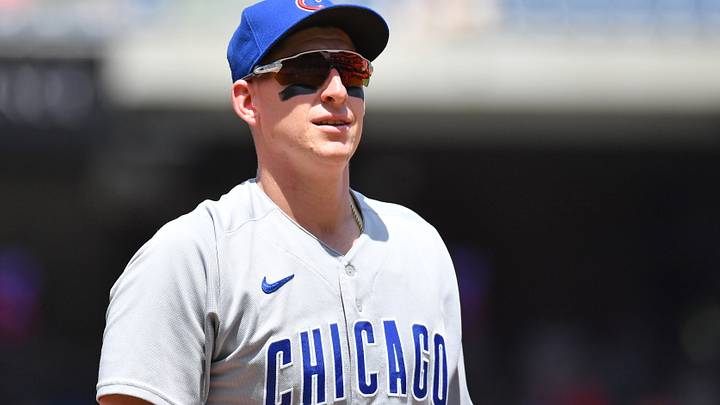
While the Chicago Cubs were sent to a frustratingly early offseason by the Padres this year, that shouldn't take away from the incredible season fans just got to watch Pete Crow-Armstrong put together in center field. It's undoubtedly one of the very best seasons in Cubs history, as he reached 40-40 while recording 10.6 fWAR (or 9.8 bWAR, if you prefer) and playing all 162 games. That sensational season brings to mind the names of other Cubs greats, like Billy Williams and Sammy Sosa.
Unfortunately, it also reminds us of how fleeting a player's peak can be. While Crow-Armstrong seems as well set-up as anyone to have a long and fruitful career with the Cubs, to the point where he's probably more likely to be a Hall of Famer than a flash in the pan, Cubs fans are all too familiar with the concept of the one-year wonder. Sometimes players look like they could be growing into stardom, but ultimately fall on their face right out of the gate.
25 Cubs one-year wonders whose brief brilliance fans will never completely forget
Let's take a look back through the last several decades of Cubs history at some of the team's one-year wonders. Some of these guys washed out of the league almost immediately, while others continued playing for a while with another team. The one thing that ties them together? If you looked at their best year with the Cubs, you'd probably think they're a lot better than they turned out to be. All players will have their position listed, as well as the years they wore a Cubs uniform.
25. 1B Frank Schwindel (2021-2022)
By far the most recent player on this list, Schwindel came to the Cubs through the waiver wire when they plucked him from the A's shortly before the 2021 trade deadline. At the time, Schwindel had just 14 MLB games under his belt while in the midst of his age-29 season. His arrival, in some ways, portended the end of the 2016 World Series-winning core. Just a week or two later, the Cubs would trade away longtime star Anthony Rizzo and pave the way for "Frank the Tank" to make his mark.
And he did exactly that, at least for half a season. In 56 games for the Cubs following Rizzo's departure, Schwindel hit like a superstar. His .342/.389/.613 slash line was eye-popping, and he managed a whopping 33 extra-base hits in just 239 trips to the plate. Entering the 2021-22 offseason, Cubs fans were dreaming on Schwindel as a possible replacement for Rizzo long-term. Unfortunately, he struggled badly across 75 games in 2022, ending his MLB career.
24. 1B/RF Bryan LaHair (2011-2012)
Ten years before Schwindel took the field for the Cubs, another flash-in-the-pan first base bat made his own debut on the north side. Bryan LaHair had come to the Cubs on a minor-league deal after a brief stint in the majors with Seattle, and he got his first opportunity with the Cubs during a 20-game stint back in 2011. LaHair made the most of it, with a .288/.377/.508 slash line across 69 trips to the plate that all but guaranteed him a spot on the 2012 roster amid the rebuild.
LaHair's heroics continued into the first half of that otherwise-dreadful 2012 campaign. In his first 66 games of the year, LaHair crushed the ball to the tune of a .288/.369/.534 hitter, picking up right where he had left off the year prior. That earned him a trip to the All-Star game over the summer, but he promptly came crashing back to earth. A .572 OPS after the All-Star break revealed the league had figured LaHair out, and he departed MLB for Japan the very next season.
23. 2B/3B Mark Bellhorn (2002-2003)
Flashing back to the early 2000s, the 2002 Cubs needed more support for Sammy Sosa in the lineup than an aging Fred McGriff could provide. Enter Mark Bellhorn, who was acquired from Oakland and almost immediately took over a regular role on the infield. His 2002 season was one for the books, as the switch-hitter slammed 27 homers with an .886 OPS. Most memorably, he became the second player in MLB history to hit homers from both sides of the plate in one inning.
Bellhorn's time with the Cubs was brief, however, and perhaps that wound up being a good thing. He struggled badly in 51 games with Chicago in 2003 before being shipped to the Rockies in June of that year. He bounced around the league for a few more years and managed to turn in a solid season for the 2004 Red Sox, but never reached the heights he found with the '02 Cubs again before playing his last MLB game as a member of the Reds in 2007.
22. C Scott Servais (1995-1998)
In June 1995, the Cubs were surprisingly competitive after a tough 1994 season and found themselves looking to add over the summer. They did so by swinging a big trade with the Astros that brought in two players: outfielder Luis Gonzalez, and catcher Scott Servais. Gonzalez, famously, went on to become an elite slugger for the Diamondbacks in the early 2000's. In the short-term, however, it was actually Servais who had the biggest impact in '95.
Servais was scorching hot in his first half-season with Chicago, slashing .286/.371/.560 with 12 doubles and 12 homers across just 52 games. Servais's hot start to his Cubs career got him plenty of chances with the Cubs over the next few years, but he managed an OPS of just .674 in his three full seasons as a Cub. Servais retired in 2001 and later managed the Mariners for nine seasons from 2016 to 2024. He now serves as a special assistant in San Diego's front office.
21. RHP Kevin Foster (1994-1998)
Right-hander Kevin Foster had just two MLB games under his belt when the Cubs acquired him from the Phillies, and when he made his team debut in 1994, he managed to put together the kind of season fans could dream on. He made just 13 starts in that rookie year after being called up for the first time in June, but he made the most of the opportunity and spun an incredibly impressive 2.89 ERA across his 81 innings of work.
That auspicious start to Foster's career gave Cubs fans hope that he could be an impact pitcher for years to come, but that wasn't meant to be. He posted a ghastly 5.01 ERA over his next four seasons in a Cubs uniform, and after missing the 1999 season due to injury, he resurfaced for just nine outings as a member of the Rangers in 2001 before his MLB career came to an end. He would go on to play in independent ball for a few years before retiring from pro ball in 2004.

20. C Rick Wilkins (1991-1995)
The first homegrown player to make this list, Wilkins was a 23rd-round pick by the Cubs all the way back in 1986. He made his MLB debut in 1991 but was more of a backup catcher than a proper starter in his first two years as a big leaguer. It was during the 1993 season when he stepped things up in a huge way. The then-26-year-old hit an unbelievable .303/.376/.561 with 30 homers and 23 doubles.
That sort of power from the catcher position is not easy to come by, and Wilkins looked like a budding superstar by the time the 1993 campaign was over. Unfortunately, that's just not how things turned out. He was a below-average hitter over the next two years, and by midseason 1995 the Cubs were ready to move on and shipped him to Houston in the aforementioned trade for Servais and Gonzalez. Wilkins stuck around MLB until he played his final game in 2001, but never rediscovered that power.
19. RHP Mike Harkey (1988-1993)
Unlike fellow homegrown player Wilkins, Harkey was drafted in the first round with plenty of hype surrounding him. He made his MLB debut with the Cubs in 1988, but appeared in just five games and did not appear in the majors during the 1989 season. Once he came up for good in 1990, he showed out with a dazzling rookie season. A 3.26 ERA across 27 starts earned him fifth place in Rookie of the Year voting that season, giving him the look of a cornerstone for the Cubs' future.
As with all of these players, however, he took a turn for the worse almost immediately. He made just 11 total starts over the next two years, and when he was finally ready to post a full MLB season in 1993, it came with a ghastly 5.26 ERA. He was pitching for Colorado by the time the 1994 season began, and his struggles continued until his career came to a close in 1997 as a member of the Dodgers.
18. LHP Mitch Williams (1989-1990)
While Harkey was out for the 1989 season due to shoulder and knee issues, the Cubs were enjoying another banner year from their pitching staff. This one came out of the bullpen, as southpaw Mitch Williams dazzled Cubs fans across an MLB-leading 76 relief outings. Acquired the offseason prior in the trade that sent Rafael Palmeiro and Jamie Moyer to the Rangers, Williams posted a sterling 2.76 ERA that earned him an All-Star nod and even top ten in both Cy Young and MVP award voting.
That elite season from Williams came a bit out of nowhere, as he had been more of a solid middle reliever than a dominant bullpen presence during his time with Texas. The heroics didn't last, as he posted a far more middling season highlighted by a 3.96 ERA in 1990 before dealing him to the Phillies for the 1991 campaign. He had a few more solid seasons in Philadelphia, but never again made an All-Star team and was on his way out of the league by his early thirties.
17. LF/1B Lloyd McClendon (1989-1990)
Williams wasn't the only flash-in-pan player to find success with the Cubs in 1989. He was joined by Lloyd McClendon, who was acquired from the Reds prior to the 1989 season. He served primarily as a platoon bat for the Cubs that year, garnering just 305 total plate appearances, but was extremely effective when he was given the opportunity to play. He slashed .286/.368/.479 with more walks than strikeouts that year.
It was enough to earn McClendon a more substantial look with the Cubs the following year, but that confidence was misplaced. McClendon struggled badly with a .469 OPS in 49 games and was off the team before the end of the year. He was a roughly league average bat for the remainder of his career and played his last MLB game in 1994 before going on to manage nearly 800 MLB games for the Pirates, Mariners, and Tigers. He last helmed a dugout in Detroit back in 2020.
16. 3B Vance Law (1988-1989)
Not many players from this era made their first All-Star game after turning 30, but Vance Law was an exception to that rule. After bouncing between the Pirates, White Sox, and Expos for years as a weak-hitting but quality fielding infielder, he joined the Cubs in 1988 and slotted in as their everyday third baseman. He performed admirably in the role, earning that aforementioned All-Star nod by playing in 151 games and slashing .293/.358/.412 to go along with his typical strong defense.
That banner year came in the twilight of Law's career, however. He returned as a starter for the 1989 season with the Cubs, but struggled badly as his OPS plummeted to just .651. He went off to Japan for the 1990 season, where he managed to crush 29 homers in 122 games, before returning to the US for a 74-game curtain call as a member of the A's to wrap up a pro career that lasted 14 seasons across all levels.

15. C Tim Blackwell (1978-1981)
Given what a taxing position it is to play for even the best of the best, it shouldn't be a surprise that there are a number of catchers on this list. The latest entrant is Tim Blackwell, who the Cubs scooped up as a free agent after the 1978 season, when he was released by the Expos. Blackwell had a career .543 OPS when he arrived at Wrigley Field, and it was mostly the same old song and dance for his first two years with the club.
A switch seemed to flip in 1980, when Blackwell turned in a brilliant performance. The strong defense behind the plate that had kept him on the roster was suddenly complemented by a perfectly respectable .745 OPS, as he posted a career-best .272 batting average with an equally-strong .352 on-base percentage. Unfortunately for Blackwell, he returned to his typical below-average numbers in 1981 before returning to the Expos for the final two years of his career.
14. 3B Steve Ontiveros (1977-1980)
While fans on the west coast might be reminded of another man of the same name who won an ERA title with the A's in 1994, this Steve Ontiveros was a corner infielder who the Cubs acquired from the Giants in February 1977. Ontiveros was a below-average hitter for his career and coming off an atrocious 1976 campaign where he hit just .176 across 59 games. Fortunately for him, his fortunes turned when he arrived in Chicago.
Ontiveros enjoyed a career year in 1977, as he hit .299/.390/.423 with 32 doubles and more walks than strikeouts. Even though he hit just ten homers, it was by far the best season of his career and seemed to announce him as the Cubs' third baseman of the future. Unfortunately, he appeared in just 265 games for the Cubs over the next three season with a lackluster .697 OPS. He played the final MLB game of his career against the Braves at Wrigley Field on June 21, 1980.
13. INF Carmen Fanzone (1971-1974)
It's not everyday you see a player who's talented enough at two things to have a second act for which he's well-known outside of baseball, but Carmen Fanzone is an exception. Acquired from Boston ahead of the 1971 season, Fanzone played for the Cubs in four seasons but only enjoyed solid offensive numbers in one of them. In 1973, Fanzone posted a respectable .797 OPS while slugging seven doubles and six homers in just 172 trips to the plate.
While Fanzone had already played his final MLB game just a year after his best offensive campaign in the majors, that was far from the end of his story. After hanging up his cleats, Fanzone enjoyed a successful career as a jazz musician that had began even before his time as a player came to an end. Today, he's perhaps better known for having played the national anthem at Wrigley Field on his trumpet than anything he did with the bat.
12. LHP Rich Nye (1966-69)
Returning to homegrown players, Rich Nye was a 14th-round pick by the Cubs in 1966 and made his MLB debut in September of that same year. He looked great in that 17-inning cup of coffee, creating big expectations headed into his rookie 1967 season. He largely delivered on that promise, throwing 205 innings with an above-average 3.20 ERA across 35 outings, including 30 starts. With a 3.14 ERA across his first 222 innings in the majors, one would think Nye's career would stay successful.
He wouldn't be on this list if that's how things went, however, so it's no surprise that things took a turn for the worse in short order. Nye's 3.80 ERA in 1968 looks good by today's standards, but it was well below average in the year of the pitcher. He lost his rotation gig by the end of the year, and in his final year with the Cubs posted an ugly 5.11 ERA. One year later, Nye was wrapping up his final year in the majors at just 25 years old.
11. RHP Bill Faul (1965-1966)
Another hurler from the 1960s who had an abbreviated career, Faul struggled badly in 103 2/3 innings across three years in Detroit before finally making his way to the Cubs in 1965. That year turned out to be the best of Faul's MLB tenure, as he spun a respectable 3.54 ERA across 17 appearances, 16 of which were starts. That was enough to earn him some starts early in the 1966 season, but he quickly spiraled.
Across 51 1/3 innings for the Cubs in his second year with the Cubs, Faul looked like he was back with the Tigers. He pitched to an ugly 5.08 ERA and was demoted to The minor leagues for the 1967 campaign before moving on from the Cubs. He briefly pitched in the majors for the 1970 Giants before wrapping hanging up his cleats after the 1973 season, which he split between the Mexican League and the Cubs' own minor league system.
10. RHP Paul Toth (1962-1964)
Continuing the trend of pitchers from the 1960s with brief careers and even briefer success in Chicago, righty Paul Toth came up as a member of the Cardinals and was dealt to the Cubs midseason in 1962. Toth was unremarkable down the stretch that year, but in 1963 he wound up playing a crucial role for Chicago. He hurled 130 2/3 innings that year between the bullpen and the starting rotation, posting an above-average 3.10 ERA as he did so.
Unfortunately, his fall from grace was just as swift as his rise to notability. Toth came crashing back to Earth in 1964 and surrendered ten runs in just 10 2/3 total innings of work for the Cubs. He was off the big league roster before the end of May and didn't make it to the majors again, for the Cubs or any other team. He stuck around in the minors for a few years but ended his pro career following the 1967 season.

9. C Sammy Taylor (1958-1962)
Sammy Taylor had an interesting start to his professional career, as he departed baseball with just 78 games under his belt to serve in the U.S. military for five years. When his service came to an end, he returned to baseball and rose through the minor leagues quickly enough to play in the majors as a 25-year-old during the 1958 season. His 96-game rookie season was unexceptional, but the following year he started to turn heads.
In 1959, Taylor hit an impressive .269/.336/428 across 110 games while playing respectable defense behind the plate. Had he been able to keep up that level of performance, it's easy to imagine he would've been a quality catcher for Chicago for years to come. Unfortunately, he simply wasn't able to keep up with the bat. The remainder of his career saw him post an OPS of just .642, and by the end of the 1962 season he had been pushed off the Cubs roster. Just one year later, he was out of MLB.
8. LF/RF Lee Walls (1957-1959)
Turning to someone who had an MLB career that was a bit more substantial, Lee Walls had spent parts of three seasons in Pittsburgh before being dealt to the Cubs in May of 1957. Walls's first year as a Cub was an ineffectual one. He turned in a lackluster .636 OPS that year, but in 1958 things turned around completely. Walls was an All-Star in 1958, and slashed an incredible .304/.370/.493 in 136 games.
That was a sensational year for Walls, but it didn't last into 1959 (much less the rest of his career). Walls was below league average the very next season, and come 1960 he was already off the Cubs. He played parts of five MLB seasons after leaving the Cubs, hitting just .248/.310/.356 before concluding his MLB career with the Dodgers at the age of 31.
7. RHP Dick Drott (1957-1961)
Right-hander Dick Drott made his MLB debut in 1957 at just 20 years old, and the Cubs immediately saw an impressive pitcher who it was easy to dream on. The righty threw 229 innings between 32 starts and 38 relief appearances while posting an above-average 3.58 ERA. That performance allowed him to finish third in Rookie of the Year voting and even secure some down-ballot MVP attention. A sign of things to come, however, was that he led all of MLB in walks that year.
Those control problems became more serious in future years. He pitched for the Cubs for four more years, and in 348 innings of work across those years me mustered an ugly 5.41 ERA. It was hardly a surprise when he was pushed to the bullpen in 1959, and even less surprising when Drott wound up in Houston for the final two years of his career before pitching his last MLB game at the age of 27.
6. RHP Don Kaiser (1955-1957)
Immediately preceding Drott's time in Chicago, the Cubs had another promising young righty wash out at the big league level: Don Kaiser. Kaiser debuted with the Cubs in 1955 at the age of 20, though he appeared in just 11 total games during that first year. 1956 was the season Kaiser made a name for himself, and it was an impressive showing. The righty tossed 150 1/3 innings to the tune of an above-average 3.59 ERA.
Unfortunately, Kaiser didn't receive the lengthy leash that Drott managed to earn himself. Instead, the righty was allowed just 72 more innings in the majors (where he posted an ugly 5.00 ERA) before he was released by the Cubs. He bounced around other teams' minor league affiliates until 1961, but never pitched in the majors again after leaving Chicago.

5. C Toby Atwell (1952-1953)
Yet another homegrown player who got off to a promising start in Chicago, Toby Atwell was an All-Star during his very first year as a big leaguer. The catcher hit .290 with more walks than strikeouts in his rookie campaign, giving him above average numbers to go with solid defense behind the dish. His time in Chicago wouldn't last much longer, however, as the Cubs traded him to the Pirates just 24 games into his 1953 campaign.
Atwell did not rediscover his rookie form in Pittsburgh, or anywhere else throughout the remainder of his career. He hit .250 with a lackluster .671 OPS in parts of four seasons with the Pirates before finishing his MLB career with the Milwaukee Braves in 1956. He played in the minors for the Braves and Orioles across two more seasons before his pro career came to a close in 1958.
4. C Bob Scheffing (1941-1950)
Sticking with catchers, Bob Scheffing might look like an odd fit for this list given his decade-long tenure as a member of the Cubs organization. The wrinkle in that, of course, is that he played just 158 total games between 1941 and 1946 due to military service. As a result of his time in the armed forces, Scheffing didn't get to properly play a full season in the majors until he was 33 years in 1947.
That very next year, Scheffing managed to defy his age and take off at the plate. In 102 games for the Cubs, he slashed an impressive .300/.351/.427 while playing solid defense behind the plate. The most impressive part of his slashing was his career-best 18 doubles, which came across just 317 trips to the plate. Unfortunately, age caught up with Scheffing after that season and he was out of MLB by 1951. He later managed the Cubs and Tigers for three seasons each in the 1950s and '60s.
3. LF Lou Novikoff (1941-1944)
When Lou Novikoff made his MLB debut at the age of 25 in 1941, it was clear he wasn't completely ready for the big leagues. The first-year Cub hit just .241 with a paltry .638 OPS while mostly riding the bench, but in his first full season as a big leaguer he fared much better. Novikoff saw his numbers skyrocket in 1942 as he slashed .300/.337/.416 across 128 games. That turned out to be not only the best year of his career, but the only one where he was an everyday player.
Novikoff returned to a part-time role in 1943, and his numbers declined with his playing time. For the rest of his career, his batting numbers hovered around league average, which ultimately made him expendable to the Cubs. He played his last MLB game for them in 1944, and his final MLB game came against his old club as a member of the Pirates on June 10, 1946.
2. CF/RF Jim Gleeson (1939-1940)
After getting a 41-game cup of coffee with Cleveland all the way back in 1936, Jim Gleeson spent two years back in the minors before he made it back to the show as a member of the Cubs. He didn't hit especially well in 1939, but the then-27-year-old was figuring things out at the highest level in a way that would pay dividends for Chicago the following year.
Come 1940, Gleeson was slashing an excellent .313/.389/.470. He hit an impressive 39 doubles and 11 triples (albeit with just four homers) in 129 games that year, making him one of the team's top offensive contributors. Unfortunately, Gleeson was not able to hold onto that elite production beyond the 1940 campaign. He was shipped to Cincinnati ahead of the 1941 season and never found his grove with the Reds, posting a .628 OPS before playing his last MLB game in May of 1942.
1. RHP Clay Bryant (1935-1940)
Clay Bryant made his MLB debut in 1935 and spent his entire career with the Cubs. 85 of his 129 total appearances as a major league pitcher came out of the bullpen, and the righty did not particularly excel in most of his time with Chicago. From 1935 to 1937, Bryant posted a middling 4.10 ERA. The final two years of his career saw him pitch in just 12 games total with an ugly 5.31 ERA in the handful of outings he made it to the mound for.
While the majority of his Cubs career looks like a footnote, 1938 was a completely different story. His 270 1/3 innings of work that year account for just under half of his total career innings, and it was a season to behold. Bryant made 30 starts and 14 relief outings that year, pitching to a strong 3.10 ERA while leading the NL in both strikeouts and walks. The righty's incredibly unusual season earned him multiple down-ballot MVP votes, and his efforts helped the Cubs make it to the World Series in 1938.
 Add us as a preferred source on Google