%20%20--%3E%0A%3Csvg%20version%3D%221.1%22%20xmlns%3D%22http%3A%2F%2Fwww.w3.org%2F2000%2Fsvg%22%20xmlns%3Axlink%3D%22http%3A%2F%2Fwww.w3.org%2F1999%2Fxlink%22%20x%3D%220px%22%20y%3D%220px%22%0A%09%20viewBox%3D%220%200%201092.7%20200%22%20style%3D%22enable-background%3Anew%200%200%201092.7%20200%3B%22%20xml%3Aspace%3D%22preserve%22%3E%0A%3Cstyle%20type%3D%22text%2Fcss%22%3E%0A%09.st0%7Bfill%3A%23231F20%3B%7D%0A%09.st1%7Bfill%3A%23293576%3B%7D%0A%09.st2%7Bfill%3A%23C82C2D%3B%7D%0A%09.st3%7Bfill%3A%23FFFFFF%3B%7D%0A%3C%2Fstyle%3E%0A%3Cg%20id%3D%22Template%22%3E%0A%3C%2Fg%3E%0A%3Cg%20id%3D%22Layer_2%22%3E%0A%09%3Cpolygon%20class%3D%22st3%22%20points%3D%2256.8%2C78.5%2073.1%2C78.5%2085.5%2C78.5%2085.5%2C36.3%2085.5%2C0%2068.8%2C0%2064.9%2C6.2%2063.3%2C8.7%2052%2C0%2025.5%2C0%2021.8%2C3.8%20%0A%09%092%2C23.8%202%2C176.2%2025%2C200%2061.5%2C200%2085.5%2C176.2%2085.5%2C121.5%2056.8%2C121.5%2056.8%2C176.2%2039.5%2C176.2%2039.5%2C32.4%2039.5%2C23.8%2056.8%2C23.8%2056.8%2C57.2%20%0A%09%09%09%22%2F%3E%0A%09%3Cpolygon%20class%3D%22st3%22%20points%3D%22143.9%2C104.2%20143.9%2C48.1%20143.9%2C24.2%20152.1%2C24.2%20153.2%2C24.2%20153.2%2C0%20152.1%2C0%20106.8%2C0%2093.9%2C0%2093.9%2C24.2%20%0A%09%09106.7%2C24.2%20106.7%2C63.4%20106.7%2C116.9%20106.7%2C175.8%20130.4%2C200%20169.2%2C200%20183%2C184.8%20191.2%2C175.8%20191.2%2C146.2%20191.2%2C96.1%20191.2%2C24.2%20%0A%09%09201.4%2C24.2%20201.4%2C0%20163.7%2C0%20158.7%2C0%20158.7%2C24.2%20163.7%2C24.2%20169.2%2C24.2%20169.2%2C75.2%20169.2%2C127.8%20169.2%2C174.1%20169.2%2C175.8%20%0A%09%09143.9%2C175.8%20143.9%2C152.9%20%09%22%2F%3E%0A%09%3Cpath%20class%3D%22st3%22%20d%3D%22M220.3%2C168v8.3h-10.5V200h62.1h12.7l28.5-23.8v-66l-5.2-5.1l-7.8-7.6l7.8-7.8l2.5-2.5V60V25.7%0A%09%09c0%2C0.7-8.6-7.9-25.7-25.7h-43H230h-20.2v23.8h10.5v96.7V168z%20M257.5%2C23.8h22.2v60.5h-22.2V23.8z%20M257.5%2C110.3h22.2v50.2v15.8h-22.2%0A%09%09v-29.4V110.3z%22%2F%3E%0A%09%3Cpath%20class%3D%22st3%22%20d%3D%22M331.9%2C176.2h-10.5v6V200h42.8h21.4h10.5l1-0.9l27.4-22.9v-56.9v-9.1l-13-12.8l10.3-10.2V25.7%0A%09%09c0%2C0.7-8.6-7.9-25.7-25.7h-74.8v23.8h10.5V45V176.2z%20M391.4%2C176.2h-5.8h-16.5v-66h22.2v17.9V176.2z%20M369.2%2C23.8h22.2v60.5H376h-6.9%0A%09%09v-5.6V23.8z%22%2F%3E%0A%09%3Cpolygon%20class%3D%22st3%22%20points%3D%22443.3%2C175.8%20433%2C175.8%20433%2C200%20463.5%2C200%20475%2C200%20489.5%2C200%20489.5%2C175.8%20480%2C175.8%20480%2C147.6%20%0A%09%09480%2C25.5%20489.5%2C25.5%20489.5%2C0%20433%2C0%20433%2C25.5%20443.3%2C25.5%20443.3%2C130.4%20%09%22%2F%3E%0A%09%3Cpolygon%20class%3D%22st3%22%20points%3D%22505.6%2C175.8%20497.9%2C175.8%20497.9%2C200%20541.3%2C200%20552.9%2C200%20583.6%2C200%20595.1%2C187.7%20595.1%2C153.9%20%0A%09%09595.1%2C140.7%20566.9%2C140.7%20566.9%2C159.5%20566.9%2C175.8%20542.6%2C175.8%20542.6%2C160.5%20542.6%2C115.8%20556.6%2C115.8%20556.6%2C133%20580.1%2C133%20%0A%09%09580.1%2C67.7%20556.6%2C67.7%20556.6%2C85%20542.6%2C85%20542.6%2C25.5%20566.9%2C25.5%20566.9%2C60.8%20595.1%2C60.8%20595.1%2C0%20497.9%2C0%20497.9%2C25.5%20505.6%2C25.5%20%0A%09%09505.6%2C155.6%20%09%22%2F%3E%0A%09%3Cpolygon%20class%3D%22st3%22%20points%3D%22682.8%2C73.5%20682.8%2C0%20669.5%2C0%20659%2C5.5%20652.7%2C0%20627.3%2C0%20603.5%2C24.2%20603.5%2C91.7%20628.1%2C116.2%20654.3%2C116.2%20%0A%09%09654.3%2C128.5%20654.3%2C176.2%20630.8%2C176.2%20630.8%2C140.6%20630.8%2C128.7%20604.5%2C128.7%20604.5%2C151%20604.5%2C200%20619.1%2C200%20625%2C200%20629.8%2C195.2%20%0A%09%09630.7%2C195.9%20637%2C200%20666.3%2C200%20687.5%2C176.2%20687.5%2C107.3%20687.5%2C106.8%20667%2C83%20635.5%2C83%20635.5%2C24.2%20656.8%2C24.2%20656.8%2C73.5%20%09%22%2F%3E%0A%09%3Cpolygon%20class%3D%22st2%22%20points%3D%22774%2C78.5%20774.8%2C78.5%20786.4%2C78.5%20802.8%2C78.5%20802.8%2C0.7%20802.8%2C0%20786%2C0%20780.5%2C8.7%20769.3%2C0%20742.8%2C0%20%0A%09%09719.3%2C23.8%20719.3%2C83.3%20719.3%2C176.2%20739%2C196.6%20742.3%2C200%20778.8%2C200%20802.8%2C176.2%20802.8%2C167%20802.8%2C121.5%20786.4%2C121.5%20774.8%2C121.5%20%0A%09%09774%2C121.5%20774%2C176.2%20756.8%2C176.2%20756.8%2C50.3%20756.8%2C23.8%20774%2C23.8%20774%2C33.1%20%09%22%2F%3E%0A%09%3Cpath%20class%3D%22st2%22%20d%3D%22M821.4%2C176.2h-10.2V200h11.2h45.8v-23.8h-6.5h-3v-65h5.5h11.7v7.6v47.7v9.7l14.7%2C23.3l0.3%2C0.4h25.2v-19v-4.8%0A%09%09h-5.5V140v-25.6l-13.3-13.3l-0.2-0.2l2.2-1.5l11.3-7.8v-2.5V24.2L882.4%2C0h-18.2h-11.6h-41.5v24.2h10.2v132.1V176.2z%20M858.7%2C24.2%0A%09%09h5.5h12.5V87h-12.5h-5.5V24.2z%22%2F%3E%0A%09%3Cpolygon%20class%3D%22st2%22%20points%3D%22934.8%2C166.2%20934.8%2C175.8%20924.5%2C175.8%20924.5%2C200%20981%2C200%20981%2C175.8%20971.5%2C175.8%20971.5%2C133.1%20%0A%09%09971.5%2C81.9%20971.5%2C25.5%20981%2C25.5%20981%2C9.1%20981%2C0%20942%2C0%20930.5%2C0%20924.5%2C0%20924.5%2C25.5%20930.5%2C25.5%20934.8%2C25.5%20934.8%2C119%20%09%22%2F%3E%0A%09%3Cpath%20class%3D%22st2%22%20d%3D%22M1089.9%2C87.2V25.7c0%2C0.6-6.4-5.8-19.3-19c-2-2.1-4.2-4.3-6.5-6.7h-31h-43.7v23.8h10.5v24.2v55.5v72.8h-10.5%0A%09%09V200h74.8l28.5-23.8v-66l-13-12.8L1089.9%2C87.2z%20M1059.4%2C176.2h-22.2v-66h22.2V176.2z%20M1059.4%2C84.2h-22.2V57.5V23.8h22.2V25V84.2z%22%0A%09%09%2F%3E%0A%3C%2Fg%3E%0A%3C%2Fsvg%3E%0A)

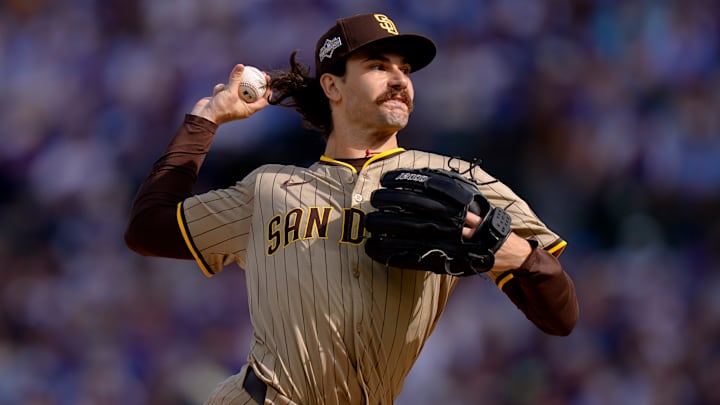
One of the biggest pitchers hitting free agency this winter is former Chicago Cubs top prospect and seven-year MLB veteran Dylan Cease. The soon-to-be 30-year old righty will be an unrestricted free agent for the first time in his career, with his AAV in 2026 is projected to be around $26.4 million per Spotrac. Only Ranger Suárez and Framber Valdez are free agents projected with a higher AAV next season.
The Cubs will need more starting pitching, ideally bringing in more velocity and whiffs to the rotation. In 2025 Cubs starters were 23rd in strikeout rate (20.5 percent), 24th in fastball velocity per Statcast (93.4), and 24th in K+ per FanGraphs. Overall the Cubs starters did a very good job last year despite not having as much high-octane stuff as other staffs, but there's work to be done looking ahead.
A new report from Bruce Levine confirms Cease is on the team's list of offseason targets - which makes digging into both the pros and cons of bringing him back into the organization a worthwhile exercise.
Our @MLBBruceLevine says MLB sources have confirmed the #Cubs will have interest in SP Dylan Cease this offseason.
— 670 The Score (@670TheScore) October 25, 2025
Bruce and @DavidHaugh are talking about Cease and a possible return to Chicago now on Inside the Clubhouse!
Hang here: https://t.co/6pC174BHJJ pic.twitter.com/CQx5mLjNgG
Cubs are expected to target Dylan Cease in free agency this winter
Pros of Cease
First of all, Cease gets whiffs. Lots of them. He boasts 1,231 career strikeouts in 1015 1/3 innings. That equates to a 10.9 K/9. Last season he sported the highest K/9 in baseball (11.5) and was in the 95th percentile in whiff rate and 89th percentile in strikeout rate. While he mixes in several pitches, Cease primarily uses his four-seamer which averaged around 97 MPH and hard slider.
Another pro for Cease has been his durability in the Majors. Since 2021, Cease has started either 32 or 33 games every season. That's 162 starts in five years. The only seasons he did not start at least 32 games was his rookie year in 2019 when he was called up during the season and the 2020 COVID year. This does not mean no future injuries will come, but having a resume of availability like this is promising.
While this area does have both pros and cons, Cease has some peripherals that look better than his ERA. He is a career 3.88 ERA pitcher, which is certainly above average but does not necessarily look elite. It's worth noting he has a career 3.67 FIP and xERA (expected ERA), both lower than his ERA. Just last year he had 4.55 ERA with a 3.56 FIP and 3.46 xERA; his BABIP against was .320 (fifth highest among qualified starters) while his xERA was in the 73rd percentile. Take this as you will, but several metrics suggest he was pitching at a higher quality than his ERA reflected.
Lastly, his dominance at Wrigley Field. The sample size is not huge, but regardless in 21 2/3 innings pitched at Wrigley (regular and postseason) he sports a 2.12 ERA, 1.04 WHIP and 32 strikeouts. Cease has overall dominated the Cubs anywhere he's faced them, but he's been great at Wrigley.
Cons of Cease
The biggest flaw that has always stuck out is the command. He's a career 3.81 BB/9 pitcher, and last year had the third-highest BB/9 among qualified starters while being down in the 20th percentile in walk rate. Even in his dominant 2.20 ERA and 3.10 FIP season in 2022, he walked the most hitters in baseball (78). Sure, he has been able to work around walks fairly often, it's still a flaw that can come back to bite. It also hurts when there are a lot of 3-1 or full counts, ramping up the pitch count. Also worth noting the 56 career wild pitches.
Another interesting nugget is he is also susceptible to flyballs. Cease was among the highest fly ball rates in 2025 (41.5 percent) among qualified starters and thus very low in the ground ball rate rankings (36.6 percent). The Cubs rotation is already filled with flyball pitchers, who had the second-highest fly ball rate (43.7 percent) as a collective in the Majors last year. Wrigley Field's weather is unpredictable, so it can either be OK or a very bad thing to have even more fly balls on a staff.
Lastly, there's been an overall inconsistency to Cease in his career. He's had some great seasons, and a handful of campaigns that left much to be desired. As mentioned before, some of his seasons have seen better FIP and expected stats than the outcome, some FIPs were still solid but not spectacular. For example followed up his 2022 Cy Young season with a 4.58 ERA, 3.72 FIP, 4.11 xERA, and 1.4 WHIP season. He's yet to really string together several All-Star or Cy Young-type campaigns consecutively. One could also bring up the career 8.47 ERA and 1.9 WHIP in the postseaon with this nugget.
Weighing the pros and cons
Pitching is expensive, and Cease will cost a lot whether it's short-term, higher AAV look or a long-term deal. As alluded to before, if you are getting 32-33 starts every year, that's worth some money alone.
He's overall been a solid arm, but it's fair to argue his flaws keep him from being elite despite possessing elite-level stuff. Can he pitch like an ace in a given game? Absolutely, he's had plenty of phenomenal starts. He's also had some real rough times in between the dominance, and can be gotten the best of on a given day.
I'd say if you are getting a 3.50-3.80 ERA pitcher who can start 33 games and generates a lot of whiffs, that's money pretty well spent. Even if it's a bit more than he's worth, that's part of the game. It's also understandable to be a bit weary of spending big money on a guy who has the flaws he has. It might really depend on how the market shapes up and what kind of offers he gets.
 Add us as a preferred source on Google