%20%20--%3E%0A%3Csvg%20version%3D%221.1%22%20xmlns%3D%22http%3A%2F%2Fwww.w3.org%2F2000%2Fsvg%22%20xmlns%3Axlink%3D%22http%3A%2F%2Fwww.w3.org%2F1999%2Fxlink%22%20x%3D%220px%22%20y%3D%220px%22%0A%09%20viewBox%3D%220%200%201092.7%20200%22%20style%3D%22enable-background%3Anew%200%200%201092.7%20200%3B%22%20xml%3Aspace%3D%22preserve%22%3E%0A%3Cstyle%20type%3D%22text%2Fcss%22%3E%0A%09.st0%7Bfill%3A%23231F20%3B%7D%0A%09.st1%7Bfill%3A%23293576%3B%7D%0A%09.st2%7Bfill%3A%23C82C2D%3B%7D%0A%09.st3%7Bfill%3A%23FFFFFF%3B%7D%0A%3C%2Fstyle%3E%0A%3Cg%20id%3D%22Template%22%3E%0A%3C%2Fg%3E%0A%3Cg%20id%3D%22Layer_2%22%3E%0A%09%3Cpolygon%20class%3D%22st3%22%20points%3D%2256.8%2C78.5%2073.1%2C78.5%2085.5%2C78.5%2085.5%2C36.3%2085.5%2C0%2068.8%2C0%2064.9%2C6.2%2063.3%2C8.7%2052%2C0%2025.5%2C0%2021.8%2C3.8%20%0A%09%092%2C23.8%202%2C176.2%2025%2C200%2061.5%2C200%2085.5%2C176.2%2085.5%2C121.5%2056.8%2C121.5%2056.8%2C176.2%2039.5%2C176.2%2039.5%2C32.4%2039.5%2C23.8%2056.8%2C23.8%2056.8%2C57.2%20%0A%09%09%09%22%2F%3E%0A%09%3Cpolygon%20class%3D%22st3%22%20points%3D%22143.9%2C104.2%20143.9%2C48.1%20143.9%2C24.2%20152.1%2C24.2%20153.2%2C24.2%20153.2%2C0%20152.1%2C0%20106.8%2C0%2093.9%2C0%2093.9%2C24.2%20%0A%09%09106.7%2C24.2%20106.7%2C63.4%20106.7%2C116.9%20106.7%2C175.8%20130.4%2C200%20169.2%2C200%20183%2C184.8%20191.2%2C175.8%20191.2%2C146.2%20191.2%2C96.1%20191.2%2C24.2%20%0A%09%09201.4%2C24.2%20201.4%2C0%20163.7%2C0%20158.7%2C0%20158.7%2C24.2%20163.7%2C24.2%20169.2%2C24.2%20169.2%2C75.2%20169.2%2C127.8%20169.2%2C174.1%20169.2%2C175.8%20%0A%09%09143.9%2C175.8%20143.9%2C152.9%20%09%22%2F%3E%0A%09%3Cpath%20class%3D%22st3%22%20d%3D%22M220.3%2C168v8.3h-10.5V200h62.1h12.7l28.5-23.8v-66l-5.2-5.1l-7.8-7.6l7.8-7.8l2.5-2.5V60V25.7%0A%09%09c0%2C0.7-8.6-7.9-25.7-25.7h-43H230h-20.2v23.8h10.5v96.7V168z%20M257.5%2C23.8h22.2v60.5h-22.2V23.8z%20M257.5%2C110.3h22.2v50.2v15.8h-22.2%0A%09%09v-29.4V110.3z%22%2F%3E%0A%09%3Cpath%20class%3D%22st3%22%20d%3D%22M331.9%2C176.2h-10.5v6V200h42.8h21.4h10.5l1-0.9l27.4-22.9v-56.9v-9.1l-13-12.8l10.3-10.2V25.7%0A%09%09c0%2C0.7-8.6-7.9-25.7-25.7h-74.8v23.8h10.5V45V176.2z%20M391.4%2C176.2h-5.8h-16.5v-66h22.2v17.9V176.2z%20M369.2%2C23.8h22.2v60.5H376h-6.9%0A%09%09v-5.6V23.8z%22%2F%3E%0A%09%3Cpolygon%20class%3D%22st3%22%20points%3D%22443.3%2C175.8%20433%2C175.8%20433%2C200%20463.5%2C200%20475%2C200%20489.5%2C200%20489.5%2C175.8%20480%2C175.8%20480%2C147.6%20%0A%09%09480%2C25.5%20489.5%2C25.5%20489.5%2C0%20433%2C0%20433%2C25.5%20443.3%2C25.5%20443.3%2C130.4%20%09%22%2F%3E%0A%09%3Cpolygon%20class%3D%22st3%22%20points%3D%22505.6%2C175.8%20497.9%2C175.8%20497.9%2C200%20541.3%2C200%20552.9%2C200%20583.6%2C200%20595.1%2C187.7%20595.1%2C153.9%20%0A%09%09595.1%2C140.7%20566.9%2C140.7%20566.9%2C159.5%20566.9%2C175.8%20542.6%2C175.8%20542.6%2C160.5%20542.6%2C115.8%20556.6%2C115.8%20556.6%2C133%20580.1%2C133%20%0A%09%09580.1%2C67.7%20556.6%2C67.7%20556.6%2C85%20542.6%2C85%20542.6%2C25.5%20566.9%2C25.5%20566.9%2C60.8%20595.1%2C60.8%20595.1%2C0%20497.9%2C0%20497.9%2C25.5%20505.6%2C25.5%20%0A%09%09505.6%2C155.6%20%09%22%2F%3E%0A%09%3Cpolygon%20class%3D%22st3%22%20points%3D%22682.8%2C73.5%20682.8%2C0%20669.5%2C0%20659%2C5.5%20652.7%2C0%20627.3%2C0%20603.5%2C24.2%20603.5%2C91.7%20628.1%2C116.2%20654.3%2C116.2%20%0A%09%09654.3%2C128.5%20654.3%2C176.2%20630.8%2C176.2%20630.8%2C140.6%20630.8%2C128.7%20604.5%2C128.7%20604.5%2C151%20604.5%2C200%20619.1%2C200%20625%2C200%20629.8%2C195.2%20%0A%09%09630.7%2C195.9%20637%2C200%20666.3%2C200%20687.5%2C176.2%20687.5%2C107.3%20687.5%2C106.8%20667%2C83%20635.5%2C83%20635.5%2C24.2%20656.8%2C24.2%20656.8%2C73.5%20%09%22%2F%3E%0A%09%3Cpolygon%20class%3D%22st2%22%20points%3D%22774%2C78.5%20774.8%2C78.5%20786.4%2C78.5%20802.8%2C78.5%20802.8%2C0.7%20802.8%2C0%20786%2C0%20780.5%2C8.7%20769.3%2C0%20742.8%2C0%20%0A%09%09719.3%2C23.8%20719.3%2C83.3%20719.3%2C176.2%20739%2C196.6%20742.3%2C200%20778.8%2C200%20802.8%2C176.2%20802.8%2C167%20802.8%2C121.5%20786.4%2C121.5%20774.8%2C121.5%20%0A%09%09774%2C121.5%20774%2C176.2%20756.8%2C176.2%20756.8%2C50.3%20756.8%2C23.8%20774%2C23.8%20774%2C33.1%20%09%22%2F%3E%0A%09%3Cpath%20class%3D%22st2%22%20d%3D%22M821.4%2C176.2h-10.2V200h11.2h45.8v-23.8h-6.5h-3v-65h5.5h11.7v7.6v47.7v9.7l14.7%2C23.3l0.3%2C0.4h25.2v-19v-4.8%0A%09%09h-5.5V140v-25.6l-13.3-13.3l-0.2-0.2l2.2-1.5l11.3-7.8v-2.5V24.2L882.4%2C0h-18.2h-11.6h-41.5v24.2h10.2v132.1V176.2z%20M858.7%2C24.2%0A%09%09h5.5h12.5V87h-12.5h-5.5V24.2z%22%2F%3E%0A%09%3Cpolygon%20class%3D%22st2%22%20points%3D%22934.8%2C166.2%20934.8%2C175.8%20924.5%2C175.8%20924.5%2C200%20981%2C200%20981%2C175.8%20971.5%2C175.8%20971.5%2C133.1%20%0A%09%09971.5%2C81.9%20971.5%2C25.5%20981%2C25.5%20981%2C9.1%20981%2C0%20942%2C0%20930.5%2C0%20924.5%2C0%20924.5%2C25.5%20930.5%2C25.5%20934.8%2C25.5%20934.8%2C119%20%09%22%2F%3E%0A%09%3Cpath%20class%3D%22st2%22%20d%3D%22M1089.9%2C87.2V25.7c0%2C0.6-6.4-5.8-19.3-19c-2-2.1-4.2-4.3-6.5-6.7h-31h-43.7v23.8h10.5v24.2v55.5v72.8h-10.5%0A%09%09V200h74.8l28.5-23.8v-66l-13-12.8L1089.9%2C87.2z%20M1059.4%2C176.2h-22.2v-66h22.2V176.2z%20M1059.4%2C84.2h-22.2V57.5V23.8h22.2V25V84.2z%22%0A%09%09%2F%3E%0A%3C%2Fg%3E%0A%3C%2Fsvg%3E%0A)

When the Chicago Cubs used their first pick, No. 17 overall, to select Wake Forest outfielder Ethan Conrad in last month’s MLB draft, they bet heavily – a $3.56 million bonus to be exact – that he was a future star.
That could certainly happen. Nico Hoerner, Ian Happ, Matt Shaw, Cade Horton and Justin Steele are among the current Cubs who came to the organization via the draft. Several, like Conrad, were first-rounders of whom much was expected.
But not every team’s first-round pick even makes it to the majors, much less stars there. Here’s a sobering statistic. Of the 30 first-round picks during the 2019 draft – players who have had time to establish themselves as MLB regulars – five have yet to make a big league appearance, while five others have played fewer than 30 games.
Drafting remains very much a hit-and-miss proposition.
Here’s a look at the Cubs’ fortunes since the 2001 draft. This presentation is broken into three parts: the five best picks, the five worst picks, and a final list of the five most obvious “might have been” picks…players whose Cubs potential was derailed by plan or fate.
The five best Cubs draft picks dating back to 2001
5. Justin Steele, 5th round, pick 139, 2014. A Mississippi high schooler when the Cubs signed him, Steele needed more than five full seasons of minor league work – not counting the non-existent 2020 season -- before finally emerging in April of 2021. But he quickly became a staff ace, making the 2023 All-Star team and finishing fifth in Cy Young Award voting when he went 16-5 in 30 starts.
4. Nico Hoerner, 1st round, pick 18, 2018. The Cubs selected Hoerner out of Stanford, his callup coming in the September 2019 playoff race. Taking over for Addison Russell at shortstop, Hoerner singled in his first at-bat and later added a 2-RBI triple in a 10-4 Cubs win. The 2023 Gold Glove winner at second base, he is a .279 career hitter with a .718 OPS and one of the leaders of the 2025 club.
3. Ian Happ, 1st round, pick 9, 2015. Selected from the University of Cincinnati, Happ spent two seasons in the minors before being called up in May of 2017. Debuting against the Cardinals in St. Louis, he struck out, but then delivered a two-run home run in the seventh. Happ finished eighth in Rookie of the Year voting, and is a three-time Gold Glove winner.
2. Javier Baez, 1st round, pick 9, 2011. A Jacksonville, Fla. high schooler when the Cubs took him, Baez starred for much of his eight seasons on the North Side, including playing a role on the 2016 World Series champions. Although his career collapsed following his 2021 deadline trade to the Mets, Baez was solid in Chicago, including a .729 OPS, two All-Star Game appearances and a runner-up finish in the 2018 MVP voting. He had a league-leading 111 RBIs that year.
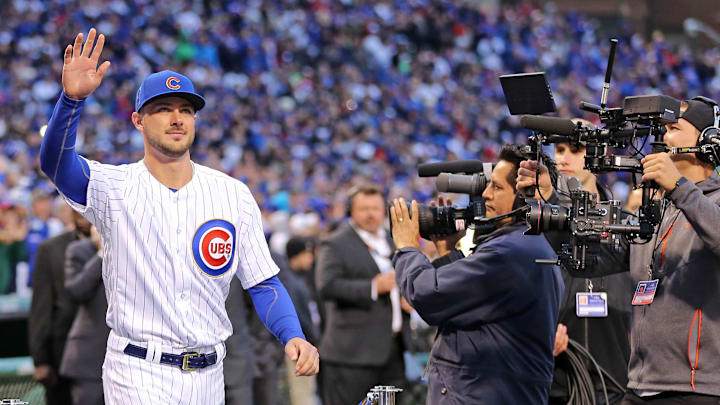
1. Kris Bryant, 1st round, second pick, 2013. Taken out of the University of San Diego, Bryant was an immediate sensation, winning Rookie of the Year in 2015 and Most Valuable Player in 2016 when he led the Cubs to their first World Series win in more than a century. Over parts of seven seasons as a Cub, Bryant produced 160 home runs and drove in 465. His decline virtually coincided with his departure from Chicago at the 2021 trade deadline. In five seasons with the Cubs he generated 27.4 WAR; in five seasons since then, his cumulative WAR is -0.6.
The five worst Cubs draft picks dating back to 2001
5. Bobby Brownlie, first round, pick 21, 2002. Brownlie was a right-handed pitcher out of Rutgers when the Cubs made him their first-round pick in 2002. He spent parts of five seasons in the team’s minor league system, compiling a 26-45 record that was topped by five starts at Triple-A Iowa. Brownlie spent three seasons in the Indians, Nationals and Braves organizations before leaving on-field duties for good in 2009. Players the Cubs could have taken that year instead of Brownlie: Matt Cain, Joey Votto, Jon Lester.
4. Mark Pawelek, first round, pick 20, 2005. Pawelek was a left-handed pitching prospect out of Utah when the Cubs signed him to head up their 2005 draft class. But he never got above A ball, going 6-11 in 26 starts spread over four seasons before being shipped off to Cincinnati. He was released in 2010 with a career 3.93 ERA. Players the Cubs could have taken that year instead of Pawelek: Jacoby Ellsbury, Brett Gardner.
3. Hayden Simpson, first round, pick 16, 2010. The Cubs gave Simpson a $1.06 million bonus to sign in 2010. A right-handed pitcher out of Southern Arkansas, he lasted only two seasons in the system, never rising above A ball, compiling a 5-17 record and 6.42 ERA. Simpson was released and caught on an independent league in 2013. Players the Cubs could have taken that year instead of Simpson: Christian Yelich, J.T. Realmuto.
2. Ed Howard, first round, pick 16, 2020. There’s still hope for Howard, a local kid taken out of Chicago’s Mt. Carmel High School as a shortstop. He remains in the Cubs system, although his only appearances to date above Double-A were 10 unimpressive games with Iowa in 2024. Howard is presently with Knoxville in the Southern Association, batting just .143 and no longer ranked a top prospect. Players the Cubs could have taken instead of Howard: Pete Crow-Armstrong, Spencer Strider, Bryce Elder, Brandon Pfaadt.
1. Ryan Harvey, first round, pick 6, 2003. Harvey was a high school outfielder when the Cubs took him No. 6 overall in 2003. He got a $2.4 million bonus to sign, in return for which the Cubs got a minor leaguer who never made it out of AA. Through six seasons in the Cubs system, Harvey batted in the .240s. The Cubs offloaded him to the Rockies in 2009, and he left baseball in 2013. Players the Cubs could have taken instead of Harvey: Adam Jones, Nick Markakis, Daniel Murphy, Andre Ethier, Jonathan Papelbon, Michael Bourn.
The five biggest 'what might have been' scenarios with Cubs' draftees
5. D J LeMahieu, second round, pick 79, 2009. How LeMahieu might have looked playing middle infield for the Cubs on those 2015-19 contenders. Unfortunately, following his 2011 debut, LeMahieu was packaged to Colorado with Tyler Colvin because the Cubs thought they needed the more experienced Ian Stewart. The trade was the worst kind of bust: Stewart hit .201 with no power while LeMahieu won the 2016 and 2020 batting titles for the Rockies and Yankees, respectively.
4. Mark Prior, 1st round, pick 2, 2001. Taken out of Southern California, Prior’s motion was considered so perfect that it was virtually injury-proof. And that was true…for a while. Debuting in 2002, he went 18-6 in 30 starts in 2003, taking the Cubs to the NLCS. But within two seasons, arm injuries took their toll. Prior made just nine starts in 2006, going 1-6 and throwing just 43 innings. Released to free agency, he signed successively with the Padres, Rangers, Yankees, Red Sox and Reds but never pitched a major league inning for any of them before retiring for good in June of 2013.
3. Kyle Schwarber, 1st round, pick 4, 2014. Drafted out of Indiana University, Schwarber became a low-average, high-power guy in Chicago. His role in the 2016 World Series win, coming back from an incapacitating injury in the season’s second game, is the stuff of legend. But the Cubs let Schwarber walk to free agency following the 2020 season, and of all their personnel losses from that championship club, he’s the one they miss. With the Phillies these past three seasons, he has an .854 OPS and 122 home runs.
2. Dylan Cease, 6th round, pick 169, 2014. Because the Cubs coveted Jose Quintana for what turned out to be a failed 2019 post-season run, the shipped top prospect Cease and Eloy Jimenez to the Soth Side that July. With the White Sox and Padres, Cease is coming up on 1,000 innings of performance, his best season being 2022 when he went 14-8 with a 2.20 ERA in 32 starts.
1. Josh Donaldson, supplemental 1st round, pick 48, 2007. Donaldson’s checkered path to the Cubs included being a first round pick several years earlier by Tampa Bay, which cut him following his 2006 suspension for violating MLB drug policies. The Cubs took a chance in 2007, but quickly reversed course and dealt Donaldson to the A’s for Rich Harden. In Oakland, Donaldson’s career blossomed. Over parts of 13 seasons, he hit 279 home runs on an .847 OPS. The 2015 AL MVP with Toronto, he played in 50 post-season games, most of them with the A’s and Jays.
 Add us as a preferred source on Google