%20%20--%3E%0A%3Csvg%20version%3D%221.1%22%20xmlns%3D%22http%3A%2F%2Fwww.w3.org%2F2000%2Fsvg%22%20xmlns%3Axlink%3D%22http%3A%2F%2Fwww.w3.org%2F1999%2Fxlink%22%20x%3D%220px%22%20y%3D%220px%22%0A%09%20viewBox%3D%220%200%201092.7%20200%22%20style%3D%22enable-background%3Anew%200%200%201092.7%20200%3B%22%20xml%3Aspace%3D%22preserve%22%3E%0A%3Cstyle%20type%3D%22text%2Fcss%22%3E%0A%09.st0%7Bfill%3A%23231F20%3B%7D%0A%09.st1%7Bfill%3A%23293576%3B%7D%0A%09.st2%7Bfill%3A%23C82C2D%3B%7D%0A%09.st3%7Bfill%3A%23FFFFFF%3B%7D%0A%3C%2Fstyle%3E%0A%3Cg%20id%3D%22Template%22%3E%0A%3C%2Fg%3E%0A%3Cg%20id%3D%22Layer_2%22%3E%0A%09%3Cpolygon%20class%3D%22st3%22%20points%3D%2256.8%2C78.5%2073.1%2C78.5%2085.5%2C78.5%2085.5%2C36.3%2085.5%2C0%2068.8%2C0%2064.9%2C6.2%2063.3%2C8.7%2052%2C0%2025.5%2C0%2021.8%2C3.8%20%0A%09%092%2C23.8%202%2C176.2%2025%2C200%2061.5%2C200%2085.5%2C176.2%2085.5%2C121.5%2056.8%2C121.5%2056.8%2C176.2%2039.5%2C176.2%2039.5%2C32.4%2039.5%2C23.8%2056.8%2C23.8%2056.8%2C57.2%20%0A%09%09%09%22%2F%3E%0A%09%3Cpolygon%20class%3D%22st3%22%20points%3D%22143.9%2C104.2%20143.9%2C48.1%20143.9%2C24.2%20152.1%2C24.2%20153.2%2C24.2%20153.2%2C0%20152.1%2C0%20106.8%2C0%2093.9%2C0%2093.9%2C24.2%20%0A%09%09106.7%2C24.2%20106.7%2C63.4%20106.7%2C116.9%20106.7%2C175.8%20130.4%2C200%20169.2%2C200%20183%2C184.8%20191.2%2C175.8%20191.2%2C146.2%20191.2%2C96.1%20191.2%2C24.2%20%0A%09%09201.4%2C24.2%20201.4%2C0%20163.7%2C0%20158.7%2C0%20158.7%2C24.2%20163.7%2C24.2%20169.2%2C24.2%20169.2%2C75.2%20169.2%2C127.8%20169.2%2C174.1%20169.2%2C175.8%20%0A%09%09143.9%2C175.8%20143.9%2C152.9%20%09%22%2F%3E%0A%09%3Cpath%20class%3D%22st3%22%20d%3D%22M220.3%2C168v8.3h-10.5V200h62.1h12.7l28.5-23.8v-66l-5.2-5.1l-7.8-7.6l7.8-7.8l2.5-2.5V60V25.7%0A%09%09c0%2C0.7-8.6-7.9-25.7-25.7h-43H230h-20.2v23.8h10.5v96.7V168z%20M257.5%2C23.8h22.2v60.5h-22.2V23.8z%20M257.5%2C110.3h22.2v50.2v15.8h-22.2%0A%09%09v-29.4V110.3z%22%2F%3E%0A%09%3Cpath%20class%3D%22st3%22%20d%3D%22M331.9%2C176.2h-10.5v6V200h42.8h21.4h10.5l1-0.9l27.4-22.9v-56.9v-9.1l-13-12.8l10.3-10.2V25.7%0A%09%09c0%2C0.7-8.6-7.9-25.7-25.7h-74.8v23.8h10.5V45V176.2z%20M391.4%2C176.2h-5.8h-16.5v-66h22.2v17.9V176.2z%20M369.2%2C23.8h22.2v60.5H376h-6.9%0A%09%09v-5.6V23.8z%22%2F%3E%0A%09%3Cpolygon%20class%3D%22st3%22%20points%3D%22443.3%2C175.8%20433%2C175.8%20433%2C200%20463.5%2C200%20475%2C200%20489.5%2C200%20489.5%2C175.8%20480%2C175.8%20480%2C147.6%20%0A%09%09480%2C25.5%20489.5%2C25.5%20489.5%2C0%20433%2C0%20433%2C25.5%20443.3%2C25.5%20443.3%2C130.4%20%09%22%2F%3E%0A%09%3Cpolygon%20class%3D%22st3%22%20points%3D%22505.6%2C175.8%20497.9%2C175.8%20497.9%2C200%20541.3%2C200%20552.9%2C200%20583.6%2C200%20595.1%2C187.7%20595.1%2C153.9%20%0A%09%09595.1%2C140.7%20566.9%2C140.7%20566.9%2C159.5%20566.9%2C175.8%20542.6%2C175.8%20542.6%2C160.5%20542.6%2C115.8%20556.6%2C115.8%20556.6%2C133%20580.1%2C133%20%0A%09%09580.1%2C67.7%20556.6%2C67.7%20556.6%2C85%20542.6%2C85%20542.6%2C25.5%20566.9%2C25.5%20566.9%2C60.8%20595.1%2C60.8%20595.1%2C0%20497.9%2C0%20497.9%2C25.5%20505.6%2C25.5%20%0A%09%09505.6%2C155.6%20%09%22%2F%3E%0A%09%3Cpolygon%20class%3D%22st3%22%20points%3D%22682.8%2C73.5%20682.8%2C0%20669.5%2C0%20659%2C5.5%20652.7%2C0%20627.3%2C0%20603.5%2C24.2%20603.5%2C91.7%20628.1%2C116.2%20654.3%2C116.2%20%0A%09%09654.3%2C128.5%20654.3%2C176.2%20630.8%2C176.2%20630.8%2C140.6%20630.8%2C128.7%20604.5%2C128.7%20604.5%2C151%20604.5%2C200%20619.1%2C200%20625%2C200%20629.8%2C195.2%20%0A%09%09630.7%2C195.9%20637%2C200%20666.3%2C200%20687.5%2C176.2%20687.5%2C107.3%20687.5%2C106.8%20667%2C83%20635.5%2C83%20635.5%2C24.2%20656.8%2C24.2%20656.8%2C73.5%20%09%22%2F%3E%0A%09%3Cpolygon%20class%3D%22st2%22%20points%3D%22774%2C78.5%20774.8%2C78.5%20786.4%2C78.5%20802.8%2C78.5%20802.8%2C0.7%20802.8%2C0%20786%2C0%20780.5%2C8.7%20769.3%2C0%20742.8%2C0%20%0A%09%09719.3%2C23.8%20719.3%2C83.3%20719.3%2C176.2%20739%2C196.6%20742.3%2C200%20778.8%2C200%20802.8%2C176.2%20802.8%2C167%20802.8%2C121.5%20786.4%2C121.5%20774.8%2C121.5%20%0A%09%09774%2C121.5%20774%2C176.2%20756.8%2C176.2%20756.8%2C50.3%20756.8%2C23.8%20774%2C23.8%20774%2C33.1%20%09%22%2F%3E%0A%09%3Cpath%20class%3D%22st2%22%20d%3D%22M821.4%2C176.2h-10.2V200h11.2h45.8v-23.8h-6.5h-3v-65h5.5h11.7v7.6v47.7v9.7l14.7%2C23.3l0.3%2C0.4h25.2v-19v-4.8%0A%09%09h-5.5V140v-25.6l-13.3-13.3l-0.2-0.2l2.2-1.5l11.3-7.8v-2.5V24.2L882.4%2C0h-18.2h-11.6h-41.5v24.2h10.2v132.1V176.2z%20M858.7%2C24.2%0A%09%09h5.5h12.5V87h-12.5h-5.5V24.2z%22%2F%3E%0A%09%3Cpolygon%20class%3D%22st2%22%20points%3D%22934.8%2C166.2%20934.8%2C175.8%20924.5%2C175.8%20924.5%2C200%20981%2C200%20981%2C175.8%20971.5%2C175.8%20971.5%2C133.1%20%0A%09%09971.5%2C81.9%20971.5%2C25.5%20981%2C25.5%20981%2C9.1%20981%2C0%20942%2C0%20930.5%2C0%20924.5%2C0%20924.5%2C25.5%20930.5%2C25.5%20934.8%2C25.5%20934.8%2C119%20%09%22%2F%3E%0A%09%3Cpath%20class%3D%22st2%22%20d%3D%22M1089.9%2C87.2V25.7c0%2C0.6-6.4-5.8-19.3-19c-2-2.1-4.2-4.3-6.5-6.7h-31h-43.7v23.8h10.5v24.2v55.5v72.8h-10.5%0A%09%09V200h74.8l28.5-23.8v-66l-13-12.8L1089.9%2C87.2z%20M1059.4%2C176.2h-22.2v-66h22.2V176.2z%20M1059.4%2C84.2h-22.2V57.5V23.8h22.2V25V84.2z%22%0A%09%09%2F%3E%0A%3C%2Fg%3E%0A%3C%2Fsvg%3E%0A)

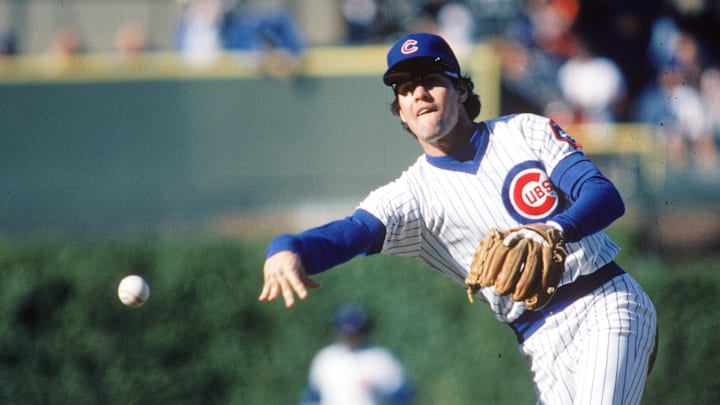
Ryne Sandberg, who died Monday at age 65, was the centerpiece of the first great team a generation of Chicago Cubs fans ever got to root for. That alone is enough to immortalize him in the memories of those fans.
Sandberg arrived in Chicago as a 22-year-old unknown in January of 1982 because Cubs GM Dallas Green, late of the Phillies, understood his star potential. The trade included shortstops Larry Bowa (to the Cubs) and Ivan DeJesus (to the Phillies), but make no mistake; that deal was all about Sandberg.
Initially installed at third base because the Cubs had Bump Wills at second, Sandberg moved to the middle infield in 1983 and stayed there for most of the next 14 seasons.
A 10-time All Star and 1984 Most Valuable Player, he won nine Gold Glove Awards.
Ryne Sandberg played 2,164 games, almost all of them in a Cubs uniform, leading to his 2005 Hall of Fame induction. Here’s a look at the five most impactful games in his career. The standard of measurement is Win Probability Added. WPA measures the proportion of a player’s contribution to a game’s outcome on a scale where +1.0 is allocated team-wide for each victory and -1.0 is allocated team-wide for each loss.
On that scale, a score of +0.4 is considered an exceptional individual contribution to a team win.
5. Sept. 1, 1992, Los Angeles Dodgers 5, Cubs 4, 13 innings. The irony of Sandberg’s career is that so many of his best individual efforts occurred in team defeats. That’s true of three of the five entries on this list, with Sandberg’s star efforts often being undermined by the ineptitude of his teammates.
Retired without incident in his first two plate appearances, Sandberg came to bat with two out and Mike Harkey at first base in the fifth inning, his team locked in a 1-1 tie with Tim Crews and the Dodgers. He hit Harkey’s first pitch into the left-center field bleachers to give the Cubs a 3-1 lead.
Harkey was, however, unable to hold that lead, so when Sandberg came up a fourth time leading off the bottom of the eighth it was in a 3-3 tie. This time he victimized Jim Gott with his second home run, a line drive scattering the bleacher bums in left-center.
Unfortunately, reliever Bob Scanlan was unable to hold that lead in the ninth, and the game plowed into extra innings tied 4-4. In the 12th, Sandberg’s third hit, a one-out single, provided a game-winning opportunity, but Roger McDowell intentionally walked Mark Grace and Jeff Kunkel hit into an inning-ending double play.
The Dodgers prevailed in 13 innings, 5-4. Sandberg WPA: +0.573.
4. June 29, 1985, Pittsburgh Pirates 6, Cubs 5, 13 innings, Three Rivers Stadium. The defending division champion Cubs were locked in a hotly contested four-way battle for supremacy when they met the last-place Pirates that evening. The Pirates unloaded on starter Dick Ruthven for three first-inning runs and led 4-1 when Sandberg, whose first-inning single had been wasted, came up with one out and two runners on base in the fifth.
His base hit scored Ruthven and sent Billy Hatcher scurrying to third base. Then with Gary Mathews in the box, Sandberg led a double steal that saw Hatcher race home with a second run. Sandberg himself scored one batter later on Keith Moreland’s double.
In the seventh, the Cubs trailing 5-4, Sandberg singled leading off, but a double play killed the threat. The Cubs still trailed 5-4 when he opened the ninth with an infield hit, taking second and third on pitcher John Candelaria’s hurried throw, which sailed into right field. Moreland’s fly ball to right field got him home, setting up another extra-inning finish.
Sandberg’s double leading off the 14th gave the Cubs a golden opportunity. But after Chico Walker struck out, Moreland was intentionally walked, Leon Durham fanned and Ron Cey flied out. The game ended suddenly in the bottom of the 15th on Pirates catcher Tony Pena’s home run. Sandberg WPA: +0.647.
3. June 18, 1991, Los Angeles Dodgers 6, Cubs 5, 13 innings, Dodger Stadium. Sandberg’s game began inauspiciously with a first-inning strikeout facing Tim Belcher. Things quickly deteriorated, the Dodgers scoring three times in the second inning off Cub starter Bob Scanlan.
They still trailed 3-0 when Sandberg came to bat with one out in the top of the sixth, Doug Dascenzo and Chico Walker on base thanks to walks. Belcher got ahead with a first pitch strike but missed over the plate and Sandberg buried it in the Dodger Stadium bleachers, a game-tying three run home run.
And so it remained through the regulation nine innings. Sandberg walked to open the 11th, stole second, reached third on an error and scored on Shawon Dunston’s base hit. But the Dodgers tied the game in the bottom half.
In the 12th, Sandberg’s ground ball single between shortstop and third scored Dascenzo, who had walked and stolen a base. But again, the Cubs' pen couldn’t protect the lead. Finally, in the bottom of the 13th, Eddie Murray singled home Juan Samuel with a run that had been set up by a Dunston error.
Sandberg WPA: +0.711.
2. July 3, 1985, Cubs 4, Philadelphia Phillies 3, Veterans Stadium. Less than a week after the disheartening 15-inning loss to the Pirates noted above, Sandberg played another decisive role, this time against the Phillies.
After being retired on a first-inning fly ball, his third-inning single sent Chris Speier across the plate with the game’s first run. He came up again in the sixth, the Cubs now trailing 2-1, with Billy Hatcher at second on a leadoff double. Sandberg walked, but was erased on a Davey Lopes double play and the Cubs failed to convert the opportunity.
Sandberg’s second base on balls, with one out in the eighth, was followed by a Lopes single that sent him to third. Moreland’s sacrifice fly got him home with the tying run.
But the Phillies broke that tie in their half of the eighth, taking a 3-2 lead into the ninth inning. With one out, Thad Bosley singled off closer Kent Tekulve, and Hatcher followed with a hit of his own. Sandberg lined a double to the wall, sending both runners across and putting the Cubs in front 4-3. Lee Smith quelled a ninth-inning comeback attempt to preserve the victory. Sandberg WPA: +0.798.
1. June 23, 1984, Cubs 12, St. Louis Cardinals 11, 11 innings. You know a player has had a special day when a particular game is inscribed with his name. This was the Sandberg Game, and it is no exaggeration to describe it as one of the greatest exhibitions of clutch hitting in baseball history.
The Cubs were in third place but only a game and a half behind the first-place Mets when the game began in front of a national TV Saturday afternoon audience. Sandberg’s first-inning single offset a Cardinal first-inning run, sending Bob Dernier home.
But a six-run Cardinals second created a deep hole, and Sandberg’s next hit, a third-inning single, went wasted in response.
The Cubs still trailed 7-1 when Sandberg batted a third time with one out and two runners on base in the fifth. His groundout to Ozzie Smith at short got a second Cubs run home, and Gary Matthews followed with a run-scoring double to draw the Cubs within four, 7-3.
The Cubs trailed 9-3 in the sixth until Sandberg’s third single capped a five-run explosion, scoring Richie Hebner and Dernier to make it 9-8. But they still trailed by that one run when Sandberg stood in against St. Louis ace closer Bruce Sutter to lead off the bottom of the ninth. He got a high splitter and sent it to the back row of the left field bleachers for a game-tying home run.
But that only tied the game. In the top of the tenth, the Cardinals hit Cubs closer Lee Smith for a pair of runs to re-assume the lead, this time 11-9. Sutter retired the first two Cubs in the bottom of the 10th, but then made the mistake of walking Bob Dernier ahead of Sandberg. For the second time in two innings, he got a belt-high splitter and rode it to almost the identical spot in the left field bleachers, again tying the game, now at 11-11.
Sandberg was not a part of the game-winning rally in the bottom of the 11th as Dave Owen’s opposite field hit scored Leon Durham. But he had done enough: five hits in six at-bats, seven RBIs, two game-tying home runs against a premier closer, and a win that will bear his name forever in Cubs lore.
The Cubs would take over the division lead less than a week later and win the first divisional title in the lifetimes of many of the club’s fans. Voters would recognize Sandberg’s contributions by voting him the Most Valuable Player Award in the National League, and the Sandberg game was the start of it all. Sandberg WPA: +1.008.
 Add us as a preferred source on Google