%20%20--%3E%0A%3Csvg%20version%3D%221.1%22%20xmlns%3D%22http%3A%2F%2Fwww.w3.org%2F2000%2Fsvg%22%20xmlns%3Axlink%3D%22http%3A%2F%2Fwww.w3.org%2F1999%2Fxlink%22%20x%3D%220px%22%20y%3D%220px%22%0A%09%20viewBox%3D%220%200%201092.7%20200%22%20style%3D%22enable-background%3Anew%200%200%201092.7%20200%3B%22%20xml%3Aspace%3D%22preserve%22%3E%0A%3Cstyle%20type%3D%22text%2Fcss%22%3E%0A%09.st0%7Bfill%3A%23231F20%3B%7D%0A%09.st1%7Bfill%3A%23293576%3B%7D%0A%09.st2%7Bfill%3A%23C82C2D%3B%7D%0A%09.st3%7Bfill%3A%23FFFFFF%3B%7D%0A%3C%2Fstyle%3E%0A%3Cg%20id%3D%22Template%22%3E%0A%3C%2Fg%3E%0A%3Cg%20id%3D%22Layer_2%22%3E%0A%09%3Cpolygon%20class%3D%22st3%22%20points%3D%2256.8%2C78.5%2073.1%2C78.5%2085.5%2C78.5%2085.5%2C36.3%2085.5%2C0%2068.8%2C0%2064.9%2C6.2%2063.3%2C8.7%2052%2C0%2025.5%2C0%2021.8%2C3.8%20%0A%09%092%2C23.8%202%2C176.2%2025%2C200%2061.5%2C200%2085.5%2C176.2%2085.5%2C121.5%2056.8%2C121.5%2056.8%2C176.2%2039.5%2C176.2%2039.5%2C32.4%2039.5%2C23.8%2056.8%2C23.8%2056.8%2C57.2%20%0A%09%09%09%22%2F%3E%0A%09%3Cpolygon%20class%3D%22st3%22%20points%3D%22143.9%2C104.2%20143.9%2C48.1%20143.9%2C24.2%20152.1%2C24.2%20153.2%2C24.2%20153.2%2C0%20152.1%2C0%20106.8%2C0%2093.9%2C0%2093.9%2C24.2%20%0A%09%09106.7%2C24.2%20106.7%2C63.4%20106.7%2C116.9%20106.7%2C175.8%20130.4%2C200%20169.2%2C200%20183%2C184.8%20191.2%2C175.8%20191.2%2C146.2%20191.2%2C96.1%20191.2%2C24.2%20%0A%09%09201.4%2C24.2%20201.4%2C0%20163.7%2C0%20158.7%2C0%20158.7%2C24.2%20163.7%2C24.2%20169.2%2C24.2%20169.2%2C75.2%20169.2%2C127.8%20169.2%2C174.1%20169.2%2C175.8%20%0A%09%09143.9%2C175.8%20143.9%2C152.9%20%09%22%2F%3E%0A%09%3Cpath%20class%3D%22st3%22%20d%3D%22M220.3%2C168v8.3h-10.5V200h62.1h12.7l28.5-23.8v-66l-5.2-5.1l-7.8-7.6l7.8-7.8l2.5-2.5V60V25.7%0A%09%09c0%2C0.7-8.6-7.9-25.7-25.7h-43H230h-20.2v23.8h10.5v96.7V168z%20M257.5%2C23.8h22.2v60.5h-22.2V23.8z%20M257.5%2C110.3h22.2v50.2v15.8h-22.2%0A%09%09v-29.4V110.3z%22%2F%3E%0A%09%3Cpath%20class%3D%22st3%22%20d%3D%22M331.9%2C176.2h-10.5v6V200h42.8h21.4h10.5l1-0.9l27.4-22.9v-56.9v-9.1l-13-12.8l10.3-10.2V25.7%0A%09%09c0%2C0.7-8.6-7.9-25.7-25.7h-74.8v23.8h10.5V45V176.2z%20M391.4%2C176.2h-5.8h-16.5v-66h22.2v17.9V176.2z%20M369.2%2C23.8h22.2v60.5H376h-6.9%0A%09%09v-5.6V23.8z%22%2F%3E%0A%09%3Cpolygon%20class%3D%22st3%22%20points%3D%22443.3%2C175.8%20433%2C175.8%20433%2C200%20463.5%2C200%20475%2C200%20489.5%2C200%20489.5%2C175.8%20480%2C175.8%20480%2C147.6%20%0A%09%09480%2C25.5%20489.5%2C25.5%20489.5%2C0%20433%2C0%20433%2C25.5%20443.3%2C25.5%20443.3%2C130.4%20%09%22%2F%3E%0A%09%3Cpolygon%20class%3D%22st3%22%20points%3D%22505.6%2C175.8%20497.9%2C175.8%20497.9%2C200%20541.3%2C200%20552.9%2C200%20583.6%2C200%20595.1%2C187.7%20595.1%2C153.9%20%0A%09%09595.1%2C140.7%20566.9%2C140.7%20566.9%2C159.5%20566.9%2C175.8%20542.6%2C175.8%20542.6%2C160.5%20542.6%2C115.8%20556.6%2C115.8%20556.6%2C133%20580.1%2C133%20%0A%09%09580.1%2C67.7%20556.6%2C67.7%20556.6%2C85%20542.6%2C85%20542.6%2C25.5%20566.9%2C25.5%20566.9%2C60.8%20595.1%2C60.8%20595.1%2C0%20497.9%2C0%20497.9%2C25.5%20505.6%2C25.5%20%0A%09%09505.6%2C155.6%20%09%22%2F%3E%0A%09%3Cpolygon%20class%3D%22st3%22%20points%3D%22682.8%2C73.5%20682.8%2C0%20669.5%2C0%20659%2C5.5%20652.7%2C0%20627.3%2C0%20603.5%2C24.2%20603.5%2C91.7%20628.1%2C116.2%20654.3%2C116.2%20%0A%09%09654.3%2C128.5%20654.3%2C176.2%20630.8%2C176.2%20630.8%2C140.6%20630.8%2C128.7%20604.5%2C128.7%20604.5%2C151%20604.5%2C200%20619.1%2C200%20625%2C200%20629.8%2C195.2%20%0A%09%09630.7%2C195.9%20637%2C200%20666.3%2C200%20687.5%2C176.2%20687.5%2C107.3%20687.5%2C106.8%20667%2C83%20635.5%2C83%20635.5%2C24.2%20656.8%2C24.2%20656.8%2C73.5%20%09%22%2F%3E%0A%09%3Cpolygon%20class%3D%22st2%22%20points%3D%22774%2C78.5%20774.8%2C78.5%20786.4%2C78.5%20802.8%2C78.5%20802.8%2C0.7%20802.8%2C0%20786%2C0%20780.5%2C8.7%20769.3%2C0%20742.8%2C0%20%0A%09%09719.3%2C23.8%20719.3%2C83.3%20719.3%2C176.2%20739%2C196.6%20742.3%2C200%20778.8%2C200%20802.8%2C176.2%20802.8%2C167%20802.8%2C121.5%20786.4%2C121.5%20774.8%2C121.5%20%0A%09%09774%2C121.5%20774%2C176.2%20756.8%2C176.2%20756.8%2C50.3%20756.8%2C23.8%20774%2C23.8%20774%2C33.1%20%09%22%2F%3E%0A%09%3Cpath%20class%3D%22st2%22%20d%3D%22M821.4%2C176.2h-10.2V200h11.2h45.8v-23.8h-6.5h-3v-65h5.5h11.7v7.6v47.7v9.7l14.7%2C23.3l0.3%2C0.4h25.2v-19v-4.8%0A%09%09h-5.5V140v-25.6l-13.3-13.3l-0.2-0.2l2.2-1.5l11.3-7.8v-2.5V24.2L882.4%2C0h-18.2h-11.6h-41.5v24.2h10.2v132.1V176.2z%20M858.7%2C24.2%0A%09%09h5.5h12.5V87h-12.5h-5.5V24.2z%22%2F%3E%0A%09%3Cpolygon%20class%3D%22st2%22%20points%3D%22934.8%2C166.2%20934.8%2C175.8%20924.5%2C175.8%20924.5%2C200%20981%2C200%20981%2C175.8%20971.5%2C175.8%20971.5%2C133.1%20%0A%09%09971.5%2C81.9%20971.5%2C25.5%20981%2C25.5%20981%2C9.1%20981%2C0%20942%2C0%20930.5%2C0%20924.5%2C0%20924.5%2C25.5%20930.5%2C25.5%20934.8%2C25.5%20934.8%2C119%20%09%22%2F%3E%0A%09%3Cpath%20class%3D%22st2%22%20d%3D%22M1089.9%2C87.2V25.7c0%2C0.6-6.4-5.8-19.3-19c-2-2.1-4.2-4.3-6.5-6.7h-31h-43.7v23.8h10.5v24.2v55.5v72.8h-10.5%0A%09%09V200h74.8l28.5-23.8v-66l-13-12.8L1089.9%2C87.2z%20M1059.4%2C176.2h-22.2v-66h22.2V176.2z%20M1059.4%2C84.2h-22.2V57.5V23.8h22.2V25V84.2z%22%0A%09%09%2F%3E%0A%3C%2Fg%3E%0A%3C%2Fsvg%3E%0A)

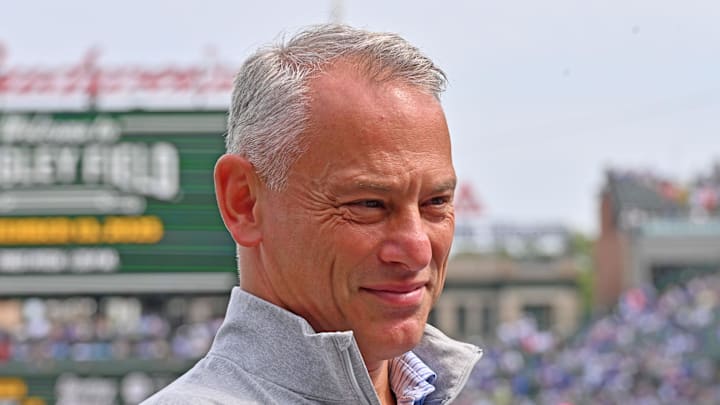
Despite overseeing the team’s first postseason appearance since 2020, Jed Hoyer has taken a lot of heat for the Chicago Cubs’ performance. Hoyer didn’t spend enough, didn’t spend it in the right places, sold the farm for one year of Kyle Tucker, placed too much faith in Matt Shaw, failed to shore up the pitching, wasn’t aggressive enough at the trade deadline, or committed a half dozen other front office sins.
Those are the allegations. What’s the reality? We know how good a season the Cubs had... so how does that translate to a front office report card?
We can answer that question by evaluating every move made by the Hoyer-Hawkins front office since the conclusion of the 2024 postseason. The standard of measurement is the cumulative Wins Above Average (WAA) of every player added to or subtracted from the team’s roster since October of 2024.
Just for context, the rating that follows compares the performance of the Cubs front office with every other NL Central front office.
There are actually five component ratings. They are: players obtained in trades, purchases or waiver transactions directly with other teams; players signed on the open market or extended for multi-season terms; farm system products; players traded, sold or waived to other teams; and players released or lost to free agency.
How does the Cubs front office stack up in the NL Central?
Acquisitions
In the NL Central, the division champion Milwaukee Brewers dominated this category. Brewers GM Matt Arnold added a dozen players over the course of the past season via direct dealings with other teams, and those dozen produced a net value to the Brewers of +2.0 games of WAA.
We’re talking here about fellows that Cubs fans are all too familiar with: Quinn Priester, Caleb Durbin and Andrew Vaughn are the three most prominent.
Hoyer’s front office beat out the other NL Central GMs for second place in the category, making a dozen transactions for a net gain of +0.4 WAA. The good news is that the acquisition of Kyle Tucker (+2.6 WAA) was easily the single most impactful trade move made by any of the division front offices. Cincinnati’s acquisition of Brady Singer (+1.7) from Kansas City was a distant second. The bad news is that the other 11 acquisitions – guys like Vidal Brujan, Taylor Rogers, Eli Morgan and Willi Castro -- totaled -2.2 WAA of impact.
In this category, the Pirates ranked third in the division with nine moves for +0.4 WAA, followed by the Cardinals (four for -1.1) and the Reds (nine for -1.2)
Free agents
Hoyer’s front office won the divisional free agency contest. The Cubs signed, re-signed or extended 13 players for a net impact of +1.4 games worth of WAA. You can probably guess the big catches without prompting. Carson Kelly was worth +2.2, Matthew Boyd added +1.0, and Brad Keller added +0.9.
The Cubs’ edge on the open market was significant; in fact it was the only front office to score a net gain via free agent signings. The Reds, with 10 signings for -0.3 WAA, were a distant second. St. Louis (four for -1.3), Milwaukee (nine for-2.6) and Pittsburgh (14 for -5.4) followed.
The Brewers’ lack of performance in this category probably reflects their status as one of MLB’s low-payroll teams. For the most part, Milwaukee’s open market ventures were for fringe players. The only two you’ve heard of were Jose Quintana and Erick Fedde, and neither was much of a factor.
Farm system products
The division’s top teams benefited most from their farm systems. Milwaukee gained +2.0 WAA from their dozen callups, that list featuring reliever Abner Uribe (+1.8), the division’s most productive rookie. Chad Patrick (+0.9), Logan Henderson (+0.8) and Isaac Collins (+0.6) were also valuable.
The Cubs’ runner-up total of+1.5 WAA was entirely attributable to Matt Shaw’s +1.7 and Caleb Horton’s +1.0. The other 10 Cubs callups were almost uniformly useless, scoring -1.2 WAA
Pittsburgh (10 callups for+0.5) was third followed by St. Louis (10 for -0.5) and Cincinnati (11 for -1.0)
Traded away
Two trades highlighted the Hoyer-Hawkins 2024-25 winter, and both come back to undermine the front office’s overall rating. They traded away Isaac Paredes, Hayden Wesneski and Cam Smith to get Kyle Tucker, then traded Cody Bellinger to New York for a pitcher they never used.
Bellinger was the significantly greater loss. He produced a +2.3 value for the Yankees. How significant is that? There were 50 players traded, sold or waived by NL Central teams to other major league teams over this time period, and none of them produced a value to the acquiring teams in excess of +0.7. Bellinger’s value to the Yankees was +2.3. As Jim Deshaies would say, that’s egregious.
The Tucker deal wasn’t quite as one-sided, but it had its downside. Smith, Paredes and Wesneski produced a net +1.1 AA in Houston.
Add it up and the Cubs gave away +3.4 games of WAA to get Tucker’s +2.3 WAA. That being the case it should come as no surprise that the Cubs front office ranked fifth out of five in the division for impact from trade losses.
Free agency losses
Hoyer and Hawkins lost or walked away from – mostly the latter – seven players to free agency, the net impact on Cubs fortunes being an improvement of +1.0 WAA. The losses were unsubstantial: Miles Mastrobuoni, Kyle Hendricks, Mike Tauchman and Genesis Cabrera being the best known.
Despite losing Willy Adames to free agency, Arnold’s Milwaukee front office won the category. The Brewers shed 13 free agents to other teams, of whom five produced values for their new teams of -0.5 WAA or worse.
Add it all up…
When the numbers from all five categories are totaled, here’s the order of finish, starting at the bottom.
5. Pittsburgh Pirates, Ben Cherington - general manager, -1.6. Cherington’s front office foundered badly in its pursuit of free agents, signing 14 at a net impact on the team of -5.4 WAA. There was no recovering from that.
4. St. Louis Cardinals, John Mozeliak - president, +1.2. In his final season as Cardinals president, Mozeliak ran a quiet operation. Consumed by the failed effort to unload Nolan Arenado, the Cardinals front office made only 28 transactions involving major league talent.
3. Cincinnati Reds, Nick Krall - president, +2.6. Krall’s advantage was the ability to avoid trading away talent. He unloaded eight former Reds to other teams, of whom none turned out to be any good. The problem was actually attracting talent; Krall’s front office was last in both trade acquisitions and farm system products.
2. Chicago Cubs, Jed Hoyer - president, Carter Hawkins - general manager. +3.4 The signings of Boyd, Kelly and Keller made the Cubs No. 1 in the division at open market activity. The team rating would have been higher but for the largesse displayed in trading away talent of the stripe of Bellinger, Paredes and Smith for short-term gain or no gain at all.
1. Milwaukee Brewers, Matt Arnold - general manager, +7.7. Arnold’s front office dominated the division, performing best in acquisitions, system products, and free agent losses. Arnold’s +7.7 game impact on Brewers' fortunes exceeded by two games the margin by which Milwaukee beat out the Cubs for the division title. Does that mean Arnold’s front office was responsible for the division championship? Statistically, you could make that argument.
 Add us as a preferred source on Google