%20%20--%3E%0A%3Csvg%20version%3D%221.1%22%20xmlns%3D%22http%3A%2F%2Fwww.w3.org%2F2000%2Fsvg%22%20xmlns%3Axlink%3D%22http%3A%2F%2Fwww.w3.org%2F1999%2Fxlink%22%20x%3D%220px%22%20y%3D%220px%22%0A%09%20viewBox%3D%220%200%201092.7%20200%22%20style%3D%22enable-background%3Anew%200%200%201092.7%20200%3B%22%20xml%3Aspace%3D%22preserve%22%3E%0A%3Cstyle%20type%3D%22text%2Fcss%22%3E%0A%09.st0%7Bfill%3A%23231F20%3B%7D%0A%09.st1%7Bfill%3A%23293576%3B%7D%0A%09.st2%7Bfill%3A%23C82C2D%3B%7D%0A%09.st3%7Bfill%3A%23FFFFFF%3B%7D%0A%3C%2Fstyle%3E%0A%3Cg%20id%3D%22Template%22%3E%0A%3C%2Fg%3E%0A%3Cg%20id%3D%22Layer_2%22%3E%0A%09%3Cpolygon%20class%3D%22st3%22%20points%3D%2256.8%2C78.5%2073.1%2C78.5%2085.5%2C78.5%2085.5%2C36.3%2085.5%2C0%2068.8%2C0%2064.9%2C6.2%2063.3%2C8.7%2052%2C0%2025.5%2C0%2021.8%2C3.8%20%0A%09%092%2C23.8%202%2C176.2%2025%2C200%2061.5%2C200%2085.5%2C176.2%2085.5%2C121.5%2056.8%2C121.5%2056.8%2C176.2%2039.5%2C176.2%2039.5%2C32.4%2039.5%2C23.8%2056.8%2C23.8%2056.8%2C57.2%20%0A%09%09%09%22%2F%3E%0A%09%3Cpolygon%20class%3D%22st3%22%20points%3D%22143.9%2C104.2%20143.9%2C48.1%20143.9%2C24.2%20152.1%2C24.2%20153.2%2C24.2%20153.2%2C0%20152.1%2C0%20106.8%2C0%2093.9%2C0%2093.9%2C24.2%20%0A%09%09106.7%2C24.2%20106.7%2C63.4%20106.7%2C116.9%20106.7%2C175.8%20130.4%2C200%20169.2%2C200%20183%2C184.8%20191.2%2C175.8%20191.2%2C146.2%20191.2%2C96.1%20191.2%2C24.2%20%0A%09%09201.4%2C24.2%20201.4%2C0%20163.7%2C0%20158.7%2C0%20158.7%2C24.2%20163.7%2C24.2%20169.2%2C24.2%20169.2%2C75.2%20169.2%2C127.8%20169.2%2C174.1%20169.2%2C175.8%20%0A%09%09143.9%2C175.8%20143.9%2C152.9%20%09%22%2F%3E%0A%09%3Cpath%20class%3D%22st3%22%20d%3D%22M220.3%2C168v8.3h-10.5V200h62.1h12.7l28.5-23.8v-66l-5.2-5.1l-7.8-7.6l7.8-7.8l2.5-2.5V60V25.7%0A%09%09c0%2C0.7-8.6-7.9-25.7-25.7h-43H230h-20.2v23.8h10.5v96.7V168z%20M257.5%2C23.8h22.2v60.5h-22.2V23.8z%20M257.5%2C110.3h22.2v50.2v15.8h-22.2%0A%09%09v-29.4V110.3z%22%2F%3E%0A%09%3Cpath%20class%3D%22st3%22%20d%3D%22M331.9%2C176.2h-10.5v6V200h42.8h21.4h10.5l1-0.9l27.4-22.9v-56.9v-9.1l-13-12.8l10.3-10.2V25.7%0A%09%09c0%2C0.7-8.6-7.9-25.7-25.7h-74.8v23.8h10.5V45V176.2z%20M391.4%2C176.2h-5.8h-16.5v-66h22.2v17.9V176.2z%20M369.2%2C23.8h22.2v60.5H376h-6.9%0A%09%09v-5.6V23.8z%22%2F%3E%0A%09%3Cpolygon%20class%3D%22st3%22%20points%3D%22443.3%2C175.8%20433%2C175.8%20433%2C200%20463.5%2C200%20475%2C200%20489.5%2C200%20489.5%2C175.8%20480%2C175.8%20480%2C147.6%20%0A%09%09480%2C25.5%20489.5%2C25.5%20489.5%2C0%20433%2C0%20433%2C25.5%20443.3%2C25.5%20443.3%2C130.4%20%09%22%2F%3E%0A%09%3Cpolygon%20class%3D%22st3%22%20points%3D%22505.6%2C175.8%20497.9%2C175.8%20497.9%2C200%20541.3%2C200%20552.9%2C200%20583.6%2C200%20595.1%2C187.7%20595.1%2C153.9%20%0A%09%09595.1%2C140.7%20566.9%2C140.7%20566.9%2C159.5%20566.9%2C175.8%20542.6%2C175.8%20542.6%2C160.5%20542.6%2C115.8%20556.6%2C115.8%20556.6%2C133%20580.1%2C133%20%0A%09%09580.1%2C67.7%20556.6%2C67.7%20556.6%2C85%20542.6%2C85%20542.6%2C25.5%20566.9%2C25.5%20566.9%2C60.8%20595.1%2C60.8%20595.1%2C0%20497.9%2C0%20497.9%2C25.5%20505.6%2C25.5%20%0A%09%09505.6%2C155.6%20%09%22%2F%3E%0A%09%3Cpolygon%20class%3D%22st3%22%20points%3D%22682.8%2C73.5%20682.8%2C0%20669.5%2C0%20659%2C5.5%20652.7%2C0%20627.3%2C0%20603.5%2C24.2%20603.5%2C91.7%20628.1%2C116.2%20654.3%2C116.2%20%0A%09%09654.3%2C128.5%20654.3%2C176.2%20630.8%2C176.2%20630.8%2C140.6%20630.8%2C128.7%20604.5%2C128.7%20604.5%2C151%20604.5%2C200%20619.1%2C200%20625%2C200%20629.8%2C195.2%20%0A%09%09630.7%2C195.9%20637%2C200%20666.3%2C200%20687.5%2C176.2%20687.5%2C107.3%20687.5%2C106.8%20667%2C83%20635.5%2C83%20635.5%2C24.2%20656.8%2C24.2%20656.8%2C73.5%20%09%22%2F%3E%0A%09%3Cpolygon%20class%3D%22st2%22%20points%3D%22774%2C78.5%20774.8%2C78.5%20786.4%2C78.5%20802.8%2C78.5%20802.8%2C0.7%20802.8%2C0%20786%2C0%20780.5%2C8.7%20769.3%2C0%20742.8%2C0%20%0A%09%09719.3%2C23.8%20719.3%2C83.3%20719.3%2C176.2%20739%2C196.6%20742.3%2C200%20778.8%2C200%20802.8%2C176.2%20802.8%2C167%20802.8%2C121.5%20786.4%2C121.5%20774.8%2C121.5%20%0A%09%09774%2C121.5%20774%2C176.2%20756.8%2C176.2%20756.8%2C50.3%20756.8%2C23.8%20774%2C23.8%20774%2C33.1%20%09%22%2F%3E%0A%09%3Cpath%20class%3D%22st2%22%20d%3D%22M821.4%2C176.2h-10.2V200h11.2h45.8v-23.8h-6.5h-3v-65h5.5h11.7v7.6v47.7v9.7l14.7%2C23.3l0.3%2C0.4h25.2v-19v-4.8%0A%09%09h-5.5V140v-25.6l-13.3-13.3l-0.2-0.2l2.2-1.5l11.3-7.8v-2.5V24.2L882.4%2C0h-18.2h-11.6h-41.5v24.2h10.2v132.1V176.2z%20M858.7%2C24.2%0A%09%09h5.5h12.5V87h-12.5h-5.5V24.2z%22%2F%3E%0A%09%3Cpolygon%20class%3D%22st2%22%20points%3D%22934.8%2C166.2%20934.8%2C175.8%20924.5%2C175.8%20924.5%2C200%20981%2C200%20981%2C175.8%20971.5%2C175.8%20971.5%2C133.1%20%0A%09%09971.5%2C81.9%20971.5%2C25.5%20981%2C25.5%20981%2C9.1%20981%2C0%20942%2C0%20930.5%2C0%20924.5%2C0%20924.5%2C25.5%20930.5%2C25.5%20934.8%2C25.5%20934.8%2C119%20%09%22%2F%3E%0A%09%3Cpath%20class%3D%22st2%22%20d%3D%22M1089.9%2C87.2V25.7c0%2C0.6-6.4-5.8-19.3-19c-2-2.1-4.2-4.3-6.5-6.7h-31h-43.7v23.8h10.5v24.2v55.5v72.8h-10.5%0A%09%09V200h74.8l28.5-23.8v-66l-13-12.8L1089.9%2C87.2z%20M1059.4%2C176.2h-22.2v-66h22.2V176.2z%20M1059.4%2C84.2h-22.2V57.5V23.8h22.2V25V84.2z%22%0A%09%09%2F%3E%0A%3C%2Fg%3E%0A%3C%2Fsvg%3E%0A)

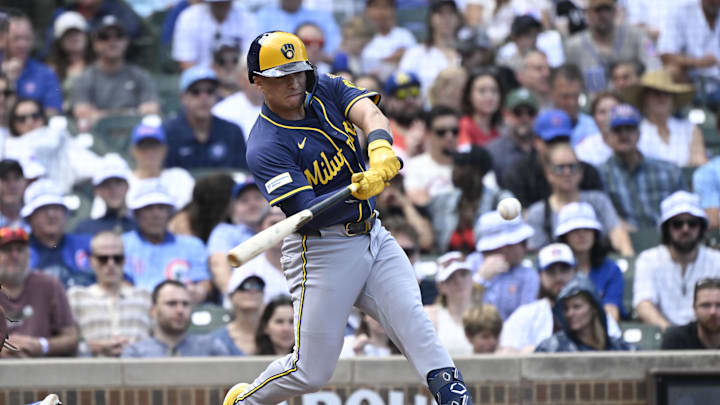
Nobody can say for sure, but the post-All-Star break portion of the NL Central race appears to come down to a battle between the Chicago Cubs and Milwaukee Brewers.
The Cubs (57-39) come out of the break with a one-game lead on Milwaukee (56-40), the Brewers leading the Cardinals and Reds by six and six-and-a-half games, respectively. So a fair question to ponder during the break is this: Which of the two Midwest rivals has the second-half edge?
I see nine useful criteria to attempt to answer that question. Some are simple and objective, others are complex and speculative. None, by the way, are guaranteed to identify the division champion three months from now.
Criteria 1: Offensive productivity. There are a lot of ways to measure productivity, but the simplest is a statistic called OPS+. In its essence, it’s on base average plus slugging average normalized for park factors and adjusted so that a score of 100 represents an era-average offense.
Through 96 games, no National League Central team – or no team in any division of MLB – has a more productive offense than the Cubs. On that scale where 100 equals MLB average, they grade out at 121, top of the heap among all 30 clubs.
The Brewers are not known for their offense, and it shows. They hit the All-Star break with a team OPS+ of 100, exactly at the MLB average, and ranking 15th among the 30 teams. Big edge to Cubs.
Criteria 2: Pitching productivity. When used to measure pitching excellence, OPS+ rebrands to ERA+, but the essential principles apply: It’s adjusted earned run average normalized to a scale where 100 equals average.
If the Brewers have edges on the Cubs, they generally involve mound work. Milwaukee’s ERA+ is 110, a figure that ranks ninth best in the majors. That’s not elite, but it’s on the fringes of upper third and it’s a darn sight better than the Cubs, back in 21st place with a staff ERA+ of 99. Big edge to Brewers.
Criteria 3: Star power. It helps to have bright lights, and those bright lights overwhelmingly play for the Cubs rather than the Brewers. The Cubs' roster features six players – Pete Crow-Armstrong, Kyle Tucker, Michael Busch, Nico Hoerner, Carson Kelly and Matt Boyd – with WARs over +2.5 at the break. Those are significantly productive players.
The Brewers counter with only one plus-2.5 WAR player, and that one, Brice Turang, only marginally counts as a star. The one drawback to this criterion is Jacob Misiorowski. WAR is a counting stat, so it is not yet impressed with the Brewers' rookie flame-thrower because of his limited workload. Big edge to Cubs.
Criteria 4: Momentum: The Cubs do take a lead into the break, but there’s no question that the Brewers are riding the hotter horse at the moment. Since June 1, they are 24-12, an exhausting .667 winning percentage. That includes series sweeps of the Twins, Pirates, Dodgers and Nationals, and they hit the break having won seven straight.
Against those numbers the Cubs look something between mediocre and decent. Chicago is 20-17 since June 1, having swept only the Guardians, and with the longest win streak being four games. Edge to Brewers.
Criteria 5: Offensive consistency. It’s one thing to run up big numbers, and often another entirely to do it with relative consistency. Generally speaking, baseball does not put great stock in consistency. You may find this surprising, but throughout the entirety of the SABRmetric revolution that has reshaped the game in the past decade, no stat has been invented to quantify consistency of performance.
We can, however, look to a very old statistical tool – standard deviation -- for insight. Thus far in 2025, the Cubs have averaged 5.35 runs per game with a standard deviation of 3.94 runs. In civilian terms, that means the only thing you can be pretty certain of regarding the Cubs offense is that it will score between 1.4 and 9.2 runs per game. Not terribly informative for day-to-day purposes.
Happily, we’re not interested in day-to-day, but in the big picture. Here’s the comparable data for the Brewers: an average of 4.73 runs per game with a standard deviation of 3.62 runs. That’s a normal spread of 1.11 at the low end and 8.35 at the high end.
In short, Milwaukee’s 3.62 standard deviation makes it slightly more predictable than Chicago’s 4.94…but the Cubs’ higher average productivity more than offsets that advantage. Edge to Cubs.
Criteria 6: Run-prevention consistency. This category is the defensive/pitching version of Criteria 5. Here are the comparables: The Cubs allow an average of 4.12 runs per game with a standard deviation of 3.2 runs; that’s a normal spread of 0.9 to 7.3 runs per game. The Brewers allow an average of 3.95 runs per game with a 3.24 standard deviation; that’s a normal range of 0.71 to 7.19. Edge to Milwaukee.
Criteria 7: Positional performance. Looking at the nine every-day positions, Cub regulars are out-performing their Brewer counterparts – as measured by Wins Above Average – at six of them: catcher, first base, second base, shortstop, center field, and right field. The Brewers win at third base and left field. As hard as it will be for Seiya Suzuki fans to accept, the DH position is a flat statistical tie.
The problem is that the Brewers win big in probably the single most important positional category, starting pitching. Yes, you can blame the losses of Steele, Taillon and Assad for this, but it doesn’t change the stats, nor does it change the likelihood of any of the three – Taillon being the possible exception – returning in time to be of much help. The Brewers also have slightly the more effective bullpen, although candidly neither pen has been all that great for more than stretches. Putting it all together, positional performance is basically a draw.
Criteria 8: Schedule. The schedule maker appears to favor the Cubs down the stretch. Their 66 remaining games include 36 against teams that right now are playing better than .500 ball, and 30 against sub-.500 teams. The Brewers also have 66 games left, but 41 of theirs are against teams now above .500, only 25 against sub- .500 teams.
The rivals have eight games left against each other, plus 18 (in the case of the Brewers) or 19 (Cubs) against NL Central rivals. They also have a half dozen common non-division opponents: the Nats, Braves, Mets, Giants, Jays and Angels. The Cubs play those teams 21 times, the Brewers 18.
The major schedule difference lies in the remaining 18 (Cubs) or 21 (Brewers) games against teams the other guy doesn’t play. For the Cubs, those games include series against the two worst teams in baseball, the Rockies and White Sox. They also play the sub.500 Orioles, Braves and Royals.
The Brewers still must play the Dodgers, Phillies, Mariners and Padres. Edge to Cubs.
Criteria 9: Changeability. The great unknown in all of this is what happens in the weeks, days and ultimately hours leading up to the trade deadline. The sense is that Cubs management has greater flexibility to patch gaps than does Brewers management.
Brewers GM Matt Arnold has never been one to make big deadline moves. Last year, the closest he came to a headline-grabber was his acquisition of pitcher Frankie Montas. With Cincinnati a 4-8, 5.01 starter, Montas made 11 starts for the Brewers and went 3-3 with a 4.55 ERA, making one wild card appearance that lasted less than four innings.
With his team sort of in contention last July, Jed Hoyer swung what sounded at the time like a big deal. He got third baseman Isaac Paredes from Tampa Bay for Christopher Morel.
The sense, which could be wrong, is that Hoyer will swing another big deal or two to reshape his team this month, while Arnold will at most tinker around the margins. Edge to Cubs.
Don’t bother adding it all up, I’ll do it for you. Of the nine criteria, the Cubs have big edges in two (offensive productivity and star power), the Brewers in one (pitching productivity). The Cubs have edges in three (offensive consistency, schedule and changeability), the Brewers in two (momentum and run prevention consistency). The teams are even in one category, positional performance.
Overall, the advantage down the stretch should go to the Cubs... just don’t bet too much on it. You know how unpredictable baseball is.
 Add us as a preferred source on Google